Investigating health behaviours in professional and recreational video gamers: The impact of role-modelling in the video game industry.
by Thai McGill*Email: mcgtl003@mymail.unisa.edu.au
Received: 23 Feb 2024 / Published: 07 Sep 2025
Abstract
Abstract
Aims: Safe work and play are important to a healthy lifestyle, and celebrities have a responsibility to role-model good practices. Our study explored health behaviours reported by recreational players and observed in video game streamers and esports players, aiming to identify whether professionals (esports/streamers) role model healthy gaming to their audiences.
Method & Results: Survey responses were collected from recreational (N=450), streamers (N=43), and esports players (N=38). Chi-Square Tests of Independence, ANOVA models, and t-tests revealed that significantly more health behaviours were used in esports, but they also experience more negative outcomes than other players. While streamers and recreational scored significantly lower than esports players, they still experienced high rates of negative outcomes from gaming, indicating more systemic protections are needed. Although professionals reported acting as good role-models, recreational players rarely noticed the health behaviours used by them, indicating differences compared to conventional sports. In addition, 20 hours of behavioural observation of video game streamers (N=20) identified a positive relationship between popularity and health behaviours performed when broadcasting.
Conclusions: We can see that professional esports players do engage in health behaviours, but also suffer significantly more from adverse effects from gaming. Further, although streamers and esports players do value these self-protective effects, they do not consistently encourage audiences to perform such behaviours, failing to use their platform for health promotion. This calls into question duty of care in the video game industry, and further research needs to identify effective role-modelling strategies to help protect gamers of all levels.
Highlights
- Esports players utilise more health behaviours than other players but still experience more negative outcomes.
- Streamers and esports players believe they are role-modelling but recreational players rarely notice health behaviours.
- Professional players fail to use their platform for health promotion.
Introduction
The esports industry has grown rapidly over the past decade, with audiences and prize money in the hundreds of millions (DiFrancisco-Donoghue et al., 2019), allowing esports to compete with and surpass many traditional sports. In addition, video game streaming (live broadcasting gameplay to an audience) is becoming increasingly popular with the money earned from it also projecting upwards (Li et al., 2020). For these reasons video gaming has become a legitimate career pathway for many, but unlike conventional sports there is little consideration for the important role that professional esports athletes play in role modelling to recreational players.
Playing video games is for the most part, a positive use of free time that can yield cognitive, motivational, emotional, and socially positive benefits (Granic et al., 2014); however, dedicating too much time to playing, combined with negative biopsychosocial habits and behaviours can lead to adverse outcomes (e.g., physical injury, video game addiction; Schary et al., 2022). Unlike traditional sports, there are no guidelines that protect players from injuries, and the consequences are apparent, as video game related issues affect all players, from recreational to full-time professionals (DiFrancisco-Donoghue et al., 2019; Migliore, 2021; Schary et al., 2022). In this study we aim to explore the differences between recreational players, esports players and video game streamers regarding their health behaviours (“overt behavioural patterns, actions and habits that relate to health maintenance, to health restoration and to health improvement”; Gochman, 1997, p.3), and further, whether role-modelling occurs from professionals to recreational players.
Esports Players and Video Game Streamers
Like traditional athletes, esports players are exposed to high levels of pressure to perform at a high standard, and therefore, spend countless hours in mostly sedentary training (Bihari & Pattanaik, 2023; DiFrancisco-Donoghue et al., 2019). With no standardised methods of assessment and treatment of game related injuries (DiFrancisco-Donoghue et al., 2019), esports players are often left vulnerable to negative biopsychosocial outcomes (Schary et al., 2022). Unlike esports players, anyone can stream due to the accessibility of streaming sites like Twitch and YouTube. Many people partake in streaming activities, with the number of viewers and streamers growing (Li et al., 2020), streaming upwards of 6-7 hours a day for five days of the week, which can generate tens of thousands of viewers. While there are large differences between skills, behaviours, and expectations of esports players and streamers, both can earn an effective income and garner large audiences. If these gaming professionals engage in health behaviours for self-protection, then through role-modelling, social learning theory may open avenues to health promotion for the wider gaming community.
Role-modelling
Social learning theory, or role-modelling, contributes to behaviour change through observable behaviours performed by influential people. Bandura and Walters (1977) outline four factors that lead to behaviour replication: 1) attention; 2) retention; 3) production; and 4) motivation. Role-modelling in the gaming industry could help educate recreational players and remove barriers by emphasising the importance of health behaviours (Janz & Becker, 1984). Although there is emerging evidence of streamers modelling health behaviours, studies have yet to explore the impact esports players have on their audience, and like traditional athletes, influential people in the gaming scene could utilise role-modelling to promote health behaviours to their audience (Bush et al., 2004). Streamers have exhibited health behaviours which were replicated by their audiences (Micallef et al., 2022), however platforms are rarely used to promote these behaviours, rather opting for marketing and advertising, largely energy drink promotions (Pollack et al., 2020). The widespread use of energy drinks in the gaming population underlines the effectiveness of the influence streamers can have over their audience, which could be used positively. This is supported by the recent popularity of blue-light glasses which are used and promoted by many streamers. These glasses supposedly assist eye and sleep health, with some studies supporting so (Franks et al., 2022); however, blue light glasses have largely been found ineffective or only minimally effective (Munsamy et al., 2022). Their popularity further demonstrates that there is a willingness for behaviour change and an increase of health behaviours in the gaming population that could be encouraged by the industry. Literature in other areas suggests that this top-down approach to learning could be effective at improving health behaviours (Bush et al., 2004) however, we still do not know how well Esports players themselves utilise health behaviours for their own health and safety (DiFrancisco-Donoghue et al., 2019; Migliore, 2021). Therefore, we propose a two-part approach in our study: (Study 1) to explore the health behaviours (and differences between professional and recreational players); and (Study 2) to further test whether such health behaviours are role modelled and recognised by audiences.
Health Behaviours
Many studies investigate negative outcomes of video gaming (e.g., see Schary et al., 2022), but few explore how to prevent these outcomes. However, we can draw comparisons to pre-existing health models offered to office workers (sedentary jobs; McGee & Ho, 2021), traditional athletes (competition and injury; White et al., 2016), and poker players (gambling and addiction; McCormack & Griffiths, 2012). Therefore, when investigating health behaviours, we set out to measure a number of key factors, including physical health (inactivity, injury); nutrition; eye health; sleep; substance-use; and mental health.
Much like office workers, all video game players are at risk of physical ergonomic injuries such as back, neck, hand, and wrist pain when not utilising health behaviours while sedentary for long periods (DiFrancisco-Donoghue et al., 2019; Schary et al., 2022). Unlike office workers, there are limited protections in place for esports players, or recommended practices for recreational players (Migliore, 2021), so for this project we look for pain management and prevention through posture, adjusting chairs and finding comfortable upper limb positions (Rodrigues et al., 2017), and muscular stretching and strengthening (Sohrabi & Babamiri, 2022). However, video gaming is inherently sedentary, meaning over-gaming leaves individuals at risk of developing unhealthy lifestyles leading to back and neck pain (Hanna et al., 2019), poor sleep hygiene, reduced cognitive function, and increased risk of anxiety and depression (Saunders et al., 2020). Elite esports players exercise as part of their training (Bihari and Pattanaik, 2023), yet 40% of a sample of college esports players reported not engaging in any physical activity (DiFrancisco-Donoghue et al., 2019). In addition, just like office workers, focusing on screens for long periods without utilising health behaviours causes eye problems in gamers (Munsamy et al., 2022), such as eye fatigue and dry eye (Schary et al., 2022).
Nutrition and sleep are important health behaviours that can impact many areas of one’s lifestyle. Nutrition plans and education from dieticians increase gaming/work performance (Kim et al., 2012; Thomas et al., 2016), healthy eating habits, and reduce negative health factors such as high cholesterol and body weight in office workers and traditional athletes (Heaney et al., 2011). Therefore, improving nutrition habits in gamers is beneficial for both health and performance.
Gaming late at night is common practice for players which can cause abnormal sleep patterns to develop. To combat this, players often use caffeine, alcohol, and/or smoking whilst gaming. For example, the gamming community has an increased caffeine consumption, particularly in over-gamers (Porter et al., 2010), which is not surprising given the endorsement of energy drinks in the esports and streaming industries (Schary et al., 2022). More worrisome is the reported use of performance-enhancing drugs amongst esports players (Schary et al., 2022). The use and formation of negative drug-use habits and poor sleep hygiene can have flow-on effects for these players, including negative health and poor injury recovery (Schary et al., 2022). The competitive nature of esports and the expectations placed upon esports players means they experience high stress (Leis et al., 2022). However, unlike traditional sports and office workers, there is little organised support and training available for stress management, forcing players to deal with stress on their own (Poulus et al., 2022).
Individually, all the above issues present problems for players; however, many of the negative outcomes of over-gaming appear to be reciprocal. For example, physical injury could result in a reduction of physical activity, and conversely, lack of physical activity can increase the likelihood of physical injury (Knapik, 2015); and poor sleep leads to poor nutrition and substance-use behaviours (Chaput, 2014), whilst good nutrition leads to improved sleep (Halson, 2008). As the reciprocal relationship suggests, promoting even one health behaviour may also improve other health behaviours.
The current study
Despite the growth of esports, there is still limited research into the promotion of health behaviours to reduce negative outcomes in video game players (Migliore, 2021). Biopsychosocial problems associated with over-gaming (Franks et al., 2022; Migliore, 2021; Schary et al., 2022), must continue to be explored as well as methods to increase health behaviours while reducing negative outcomes. If professional esports players and streamers are role-modelling good practices to their viewership then they have an important platform for health promotion. This paper presents two studies:
Study 1 – Health behaviours
Study 1 uses a survey to explore the following research questions:
RQ1: Are there differences between esports players, streamers, and recreational players regarding health behaviours that they use to reduce biopsychosocial problems from gaming?
Then, as a prelude to Study 2, we ask:
RQ2: Do esports players and streamers show or talk about the health behaviours they use in a public setting?
RQ2a: Are these behaviours noticed by recreational players?
Study 2 – Role Modelling
Like other jobs, people can work casual, part-time, full-time, etc., in the gaming industry; therefore, it is expected that the more people treat gaming as a professional job or career, the more health behaviours they will use. The best way to measure role-modelling is through behavioural observation (Epp et al., 2012), and no studies have done this with a video game streamer sample before.
Study 2 uses behavioural observation on streamers to test the predicted hypothesis:
H1: The more professional a streamer is the more health behaviours they use.
Methods
Study 1
Participants
The sample (N=527) consists of three gamer types: (1) recreational players (n=450); (2) esports players (n=38); and (3) streamers (n=43). Recreational players are people who play video games in their spare time for entertainment; esports players are people who play in high-levels of esports competitions, usually in a team, and make at least part of their income from gaming; and streamers are people who live stream themselves playing video games publicly online. The collected sample had a median age of 26 and 356 men, 151 women, and 19 people who identified differently. 346 participants indicated that PC was their preferred console. The majority of participants (N=276) played almost daily, and the most popular gaming session length was 3-4 hours (N=124). Participants had to be 16+ years, self-identify as a player, and live in one of the 30 countries included with a free national helpline (including prominent esports countries such as South Korea, China, Germany, and USA).
Materials
An online survey was hosted on the Qualtrics platform. The short form International Physical Activity Questionnaire (IPAQ; Craig et al., 2003) was used in the survey. It is a 7-day recall of physical activity that measures the number of days, hours, and minutes participants have performed vigorous and moderate activity, walking, and sitting behaviours in the past week. An example question is as follows: “How many days did you do vigorous physical activities in the last 7 days?”. The answers are categorised into one of three: (1) inactive; (2) minimally active; or (3) HEPA (health-enhancing physical activity) active. In addition, the IPAQ produces a continuous ‘MET Score’ (Metabolic equivalent) to examine physical behaviours. The MET is a stronger indicator of how vigorous the activities participants report are. The IPAQ has high test-retest reliability (α<.80; Craig et al., 2003). The survey also measured additional game behaviours, health behaviours, game related injuries, and lifestyle behaviours (see Table 1), and experiences watching esports and streamers. Participants who indicated that they were an esports player or streamer, completed additional questions asking about their streaming/competitive practices. Responses were on 5-point Likert scales.
A final block of questions were presented according to their professional vs. recreational player status. Esports players and streamers were asked additional questions regarding their experiences with occupational injuries, and how often they perform or discuss health behaviours in public settings (e.g., live streaming; interviews); recreational players were asked about the frequency they noticed these health behaviours when watching esports players and/or streamers.
Table 1 - Health behaviours and negative behaviours/outcomes asked about in the survey| Physical | Psychosocial/lifestyle | |
|---|---|---|
| Breaks Stretching Ergonomic chair use Use a standing/active desk Wrist protection use Looking away from the screen Playing in a room with a window Playing an appropriate distance from the screen Wrist pain* Back pain* Hand/finger pain* Sore/dry eyes* Blue light glasses See a physiotherapist Other physical health behaviours Other negative physical outcomes* | 8 hours of sleep 5 portions of fruit and vegetables Sugary, fatty, or salty foods* Keep water near Drink an appropriate amount of water Drink energy drinks* Drink alcohol* Use drugs* Gamble* Use drugs to enhance gaming performance (PEDs)* Experience depression/anxiety* Play video games with friends See friends in person Rage quit* Flame* See a psychologist Other work/hobby that involves electronic devices* Other psychosocial health behaviours Other negative psychosocial* |
Note. Rage quitting is getting angry at the game and flaming is getting angry at other players. * Negative behaviour/outcome. All other variables are health behaviours.
Procedure
As participants self-selected into groups (esports player; streamer; recreational player), Study 1 used a mixed-methods observational design to answer RQ1 and RQ2. Following approval from the University of South Australia’s human research ethics committee, participants were recruited through paid social media advertisements and posts, gaming forums posts, and posters displayed around campuses. Participants were directed to the Qualtrics platform to complete a 10–15-minute survey. Participants were asked what type of player they were (recreational players, esports players, or video game streamers), along with the IPAQ and health behaviours and outcomes.
Study 2
Participants
Twenty hours of online video content from different streamers (N=20) were viewed for behavioural observation. As anyone can stream and revenue is not always public, the participants of this group were ranked by ‘professionality’ based on subscriber count (higher subscribers indicated higher ‘professionality’, i.e., their larger viewership and therefore revenue raised as an indication that they treat streaming more like a job than a hobby). Demographic and stream information can be found in Table 2.
Procedure
Study 2 used a cross-sectional behavioural observation design. From Study 1, streamer participants could opt-in for further observational study in Study 2; n=10 participants were selected from Study 1 to undergo behavioural observation (Epp et al., 2012) for Study 2. These participants were selected according to free access to pre-recorded live streams or if they were live streaming at the time of observation. Participants were observed for 60 minutes between 9 a.m. and 5 p.m. ACST (Australian Central Standard Time) for any of the variables in Table 3.
Unfortunately, there were no ‘high-level’ streamers (majority of income from streaming) who opted-in from Study 1, therefore a further n=10 of the highest viewed streamers on Twitch were selected to participate, facilitating comparison with the lower-subscriber streamers that opted-in; these ‘top 10’ streamers varied across game types. Demographic data on all 20 streamers can be found in Table 2. The observational data were used to answer H1: professionality of streamers and their use of health behaviours. Study 2 also allowed for further insight into RQ2 in the form of role-modelling effectiveness, as well as the health and habits of streamers.
Table 2 — Study 2 streamer demographics and stream information| Rankin g | Subscriber s | Curren t Viewer s | Donation s | Game Type Face | camer a | Espor t status | Surve y status | ||||||||
|---|---|---|---|---|---|---|---|---|---|---|---|---|---|---|---|
| 1 | 6.2 m | 12,665 | 1 | Competitiv e | Yes | Yes | No | ||||||||
| 2 5.2 m 11,388 10 Competitiv Yes No No e | |||||||||||||||
| 3 | 2.1 m | 9,916 | 31 | Co-op | Yes | No | No | ||||||||
| 4 1.7 m 3,415 10 Competitiv Yes Yes No e | |||||||||||||||
| 5 | 931 k | 12,628 | 3 | Single Player | Yes | No | No | ||||||||
| 6 792 k 2,930 5 Competitiv Yes Yes No e | |||||||||||||||
| 7 | 492 k | 10,358 | 5 | Co-op | Yes | No | No | ||||||||
| 8 233 k 6,551 17 Competitiv Yes Yes No e | |||||||||||||||
| 9 | 186 k | 1,140 | 1 | Co-op | Yes | No | No | ||||||||
| 10 108 k 6,248 1 Competitiv Yes Yes No e | |||||||||||||||
| 11 | 791 | 227 | 2 | Competitiv e | No | No | Yes | ||||||||
| 12 549 2 0 Single Yes No Yes Player | |||||||||||||||
| 13 | 376 | 60 | 0 | Single Player | Yes | No | Yes | ||||||||
| 14 218 58 0 Competitiv Yes No Yes e | |||||||||||||||
| 15 | 183 | 6 | 0 | Competitiv e | No | No | Yes | ||||||||
| 16 180 29 0 Single No No Yes Player | |||||||||||||||
| 17 | 179 | 0 | 0 | Competitiv e | Yes | No | Yes | ||||||||
| 18 60 24 0 Co-op Yes No Yes | |||||||||||||||
| 19 | 35 | 4 | 0 | Competitiv e | No | No | Yes | ||||||||
| 20 34 48 1 Co-op No No Yes |
Note. Esports status includes retired esports players
Table 3 — The definition and categorisation of variables looked for in behaviour observation| Categories | Variable s | Variable definitions | |
|---|---|---|---|
| Environmental | Environ ment positive | Anything visible on camera that relates to one of the positive aspects below | |
| Environ Anything visible on camera that relates to one of the negative aspects below ment negative | |||
| Positive Physical | Positive hand | Any visible or talked about stretches or protection for the hand or fingers | |
| Positive Any visible or talked about stretches or protection for the wrist wrist or arm | |||
| Positive back | Any visible or talked about stretches or protection for the back | ||
| Positive Any visible or talked about stretches or protection for the neck neck | |||
| Positive eyes | Any visible or talked about protection for the eyes | ||
| Breaks If they leave the stream for a period of time | |||
| Positive posture | They sit in the recommended posture | ||
| Negative Physical Negative Any visible or talked about pain or discomfort for the hand hand or fingers | |||
| Negative wrist | Any visible or talked about pain or discomfort for the wrist or arm | ||
| Negative Any visible or talked about pain or discomfort for the back back | |||
| Negative neck | Any visible or talked about pain or discomfort for the neck | ||
| Negative Any visible or talked about pain or discomfort for the eyes eyes | |||
| Negative posture | They do not sit in the recommended posture | ||
| Positive Positive They talk about or show healthy food Psychosocial/Lifest food yle | |||
| Positive beverage | They drink water | ||
| Positive They talk about the negative aspects of gambling and/or gambling dissuades the audience from doing it | |||
| Positive drugs/sm oking | They talk about the negative aspects of drugs and/or dissuade the audience from doing them | ||
| Positive They talk about exercise, sports or movement in a exercise positive way |
| Positive sleep | They talk about the importance of sleep and/or their own sleep in a positive way | ||||
|---|---|---|---|---|---|
| Positive They talk about mental health in a way that normalises it mental and/or positive ways to manage it health | |||||
| Positive social | They are playing or talking with friends, they talk about seeing friends, they interact with strangers in-game positively | ||||
| Positive They control their emotions in situations that could regulatio induce rage (ie. Dying, losing, being flamed) n | |||||
| Negative Psychosocial/Lifest yle | Negative food | They talk about or show unhealthy food | |||
| Negative They talk about, show, or drink unhealthy beverages beverage | |||||
| Negative gambling | They talk about gambling in a way that promotes or encourages it | ||||
| Negative They talk about drug use in a way that promotes or drugs/sm encourages it oking | |||||
| Negative exercise | They talk about their lack of exercise or dissuade their audience from exercising | ||||
| Negative They yawn, talk about how tired they are, how long it has sleep been since they slept, or that they go to bed at an hour past midnight | |||||
| Negative mental health | They talk about mental health in an unhealthy way that promotes negative feelings, behaviours, or coping strategies and/or stigmatises mental health | ||||
| Negative They talk about being isolated, not going out, or interact social with strangers in game negatively | |||||
| Negative regulatio n | They physically or verbally show anger towards the game, other players, themselves, or their environment | ||||
| Encouragement Positive They visually or verbally encourage the audience to do audience positive behaviours encourag ement | |||||
| Negative audience encourag ement | They visually or verbally encourage the audience to do negative behaviours |
Note. 1 frequency = 1 instance of behaviour
Results
Health Behaviours (Study 1)
Data were screened, cleaned, re-coded and labelled. Content analysis was performed on the IPAQ results and calculated accordingly (Craig et al., 2003). To differentiate participants who actively engaged in health behaviours and those who did not, health behaviours (Table 1) were recoded into a dichotomous variable: those who responded with 4 or 5 on the Likert scale were coded as “more than half the time”; those who indicated 3 or less on the Likert scale were coded as “half or less than half of the time”. Similarly, negative outcomes and behaviours (Table 1) were re-coded as dichotomous variables following the same recode pattern. This identified and separated participants who performed the behaviours habitually and actively (do so more than half the time) and are therefore more likely to be engaging in conscious behaviour. The sum of all positive health behaviours was calculated to create a total positive health score, ranging from 0-19 with a higher score indicating more positive health behaviours. The same was done for negative behaviours and outcomes to create a total negative health score ranging from 0-17.
A similar dichotomisation was completed for the rate professionals talk about health behaviours in public, and how often recreational players hear this (Hear/talk); and the rate professionals perform health behaviours in public, and how often recreational players notice these (See/do).
RQ1 - Differences Between Players and Health Behaviours (Study 1)
A Chi-square test of independence was produced to compare the observed and expected count for health behaviours and negative outcomes for the three player types: recreational players, esports players, and video game streamers. Assumptions of frequencies, and mutually exclusive categories were satisfied. The test found moderate significant differences in ergonomic chair use, other physical health behaviours, and rage quitting (getting angry at the game); and strong significant differences in wrist protection, wrist pain, neck pain, hand pain, energy drink consumption, playing with friends, active desks, and physiotherapist. A very weak effect size was also found in other negative mental/lifestyle outcomes. All significant differences indicated higher levels in esports players, except for playing with friends which was higher in both esports players and streamers. Table 4 displays the significant results and effect sizes.
Table 4 — Significant Chi-square test results between groups. φc=Cramer’s VNote. ES = Effect| Recreational | Coun t | Exp | Streamer Count | Exp | Esports Count | Exp | χ2 | df | p | φc | ES | ||
|---|---|---|---|---|---|---|---|---|---|---|---|---|---|
| Ergonomic Chair | 161 | 171.5 | 17 | 16.2 | 24 | 14.3 | 11.85 | 2 | .003 | .151 | M | ||
| Wrist Protection | 53 | 58.5 | 1 | 5.7 | 15 | 4.9 | 29.26 | 2 | <.001 | .236 | S | ||
| Wrist Pain | 82 | 92.3 | 9 | 8.8 | 18 | 7.9 | 17.68 | 2 | <.001 | .184 | S | ||
| Neck Pain | 104 | 115.1 | 12 | 11.1 | 20 | 9.8 | 15.74 | 2 | <.001 | .173 | S | ||
| Hand Pain | 79 | 83.7 | 6 | 8.1 | 14 | 7.2 | 8.96 | 2 | .011 | .131 | S | ||
| *Other physical behaviour | 144 | 150.0 | 14 | 14.5 | 19 | 12.5 | 21.56 | 4 | <.001 | .143 | M | ||
| *Physiotherapi st | 33 | 40.6 | 3 | 3.9 | 12 | 3.5 | 28.00 | 6 | <.001 | .163 | S | ||
| Energy Drinks | 77 | 88.8 | 8 | 8.6 | 20 | 7.6 | 27.30 | 2 | <.001 | .228 | S | ||
| Play with Friends | 213 | 227.6 | 31 | 22.0 | 25 | 19.4 | 12.73 | 2 | .002 | .156 | S | ||
| Active Desk | 58 | 68.5 | 6 | 6.6 | 17 | 5.9 | 26.90 | 2 | <.001 | .227 | S | ||
| Rage Quit | 37 | 39.0 | 2 | 3.8 | 7 | 3.2 | 6.09 | 2 | .048 | .108 | M | ||
| *Other negative mental | 52 | 57.6 | 6 | 5.5 | 10 | 4.9 | 10.32 | 4 | .03 | .032 | VW |
Note. Size; VW = very weak; M = moderate; S = strong. Effect size interpretations based on medical effect size thresholds Akoglu (2018). * = Results reported for those who said they partake in behaviour rather than Likert scale results; Exp = Expected
Overall comparison of positive health behaviours
A one-way Between-groups ANOVA was conducted to measure differences between player type and total positive health score. Assumptions of normality and linearity were met. The ANOVA was significant with a small to medium effect size, N=527, F(2, 524)=7.89, p<.001, hp 2 =.029. Levene’s assumption of homogeneity was violated, therefore Dunnett’s T3 was used for Post Hocs. Significant differences between esports players and recreational players were found, p=.017. There was sufficient observed power (>0.8) and planned comparison was conducted via t-tests. The independent samples t-test further revealed a significant difference with a medium effect size between esports players total positive health score (M=9.16, SD=4.52) and recreational players (M=6.98, SD=3.29), N=484, t(40.41)=-2.91, p=.006 (two-tailed), d=-.642.
Overall comparison of negative health behaviours
A one-way Between-groups ANOVA was performed to measure the total negative health score between gamer types. The assumption of linearity was met, but normality was not for recreational players, therefore Total negative health scores were transformed into z-scores to find outlier(s); n=11 recreational players and n=3 esports players were removed for the ANOVA as they surpassed the threshold (3.3 for recreational players; 2 for esports players). The
ANOVA was significant with a small to medium effect size: N=513, F(2, 510)=6.196, p=.002, h2=.024. Levene’s was met, therefore, Bonferroni post hocs were consulted. This displayed significant differences between recreational players and esports players, p=.002. There was sufficient observed power (>0.8), therefore, planned comparisons were conducted through via a t-test. Levene’s was violated. The independent samples t-test indicated that esports players total negative health score (M=4.37, SD=2.94) was significantly more than recreational players (M=2.96, SD=2.29) with a medium effect size, N=470, t(37.38)=-2.77, p=.009 (two-tailed), d=-.602.
RQ2 - Using and Noticing Health Behaviours in Public (Study 2)
A Chi-Square Test of Independence was produced to compare professionals and Recreational players in the See/Do and Hear/Talk variables. A significant moderate difference was found in Hear/Talk with Recreational players underperforming (Hear) and professionals overperforming (Talk). A significant strong difference was found in See/Do with the same pattern outcome as Hear/Talk. See Table 5 for results.
| Table 5 Chi-square results of ‘hear/talk’ and ‘see/do’ variables | |||||||||||||||||||
|---|---|---|---|---|---|---|---|---|---|---|---|---|---|---|---|---|---|---|---|
| Count | Recreational | Expected | Count | Professionals | Expected | χ2 | df | p | φ | Effect Size | |||||||||
| Hear/talk | 78 | 85.4 | 23 | 15.6 | 10.89 | 2 | .004 | .144 | Moderate | ||||||||||
| See/do | 84 | 98.9 | 33 | 18.1 | 24.58 | 2 | <.001 | .217 | Strong |
Note. Counts are participants who reported these variables ‘more than half the time’ on a Likert scale. Φ=Phi. Effect size interpretations based on medical effect size thresholds Akoglu (2018).
The 20 streamers subject to behaviour observation were ranked according to subscriber count. A Spearman’s rank order correlation was conducted to find where health behaviours differ depending on the ‘professionality’ of a streamer. In isolation, significant correlations occurred in environment positive, breaks, negative hand, positive physical total, positive food, positive sleep, positive lifestyle total, and negative regulation. A multiple (forced entry) regression was conducted with these variables; positive physical total and positive lifestyle total were excluded as they were sums of other variables. Assumptions of normality of residuals, and homoscedasticity were met; there were no multivariate outliers or multicollinearity present. There were two influential cases present, however, these cases were included due to the small sample size. The regression was significant: R2=.81, F(6, 13)=4.01, p=.017. However, only negative hand was a significant predictor of professionality, β=-.415 (standardised), p=.049; all the other variables were non-significant predictors (see Table 6).
Table 6 — Multiple regression exploring health behaviours and streamer professionality| Variables | B | SE | β | t | p | ||||||
|---|---|---|---|---|---|---|---|---|---|---|---|
| (Constant) | 14.680 | 2.111 | 6.953 | <.001* | |||||||
| Environment Positive | -1.105 | 1.105 | -.249 | -.999 | .336 | ||||||
| Breaks | -1.059 | 2.082 | -.148 | -.509 | .619 | ||||||
| Negative Hand | -2.347 | 1.078 | -.415 | -2.176 | .049* | ||||||
| Positive Food | -.007 | 1.893 | -.001 | -.004 | .997 | ||||||
| Positive Sleep | 4.372 | 3.469 | .227 | 1.261 | .230 | ||||||
| Negative Regulation | -.328 | .341 | -.232 | -.962 | .354 |
Note. B = unstandardised; β = Standardised
*Indicates significant results
Data were split into Top 10 (T10), and Bottom 10 (B10) based on ‘professionality’ ranking. The correlated variables above were checked for normality; both groups were not normally distributed, therefore, variables were converted into z-scores. 3 participants were excluded (T10=1, B10=3) as they exceeded the threshold. Seven Independent Sample t-tests were performed for the above variables. The T10 streamers scored significantly higher for environment positive, negative eyes, negative physical total, and positive lifestyle total than B10.
Table 7 — T-test results comparing Top 10 and Bottom 10 streamers observed behaviours| L | df | p(one-sided) | Mean Difference | Std. Error Difference | Lower Upper | d | T10 Mean (SD) | B10 Mean (SD) | |||||
|---|---|---|---|---|---|---|---|---|---|---|---|---|---|
| Environment Positive* | NV | 14 | <.001 | 2 | .467 | .999 | 3.001 | .926 | 3 (1) | 1 (.866) | |||
| Negative Eyes* | NV | 14 | .005 | .603 | .205 | .163 | 1.043 | .407 | .71 (.488) | .11 (.333) | |||
| Negative Posture | V | 6 | .052 | .561 | .297 | -.156 | 1.299 | .515 | .57 (.787) | 0 (0) | |||
| Negative Physical Total* | V | 8.08 | <.001 | 2.95 | .613 | 1.542 | 4.363 | 1.116 | 3.29 (1.496) | .33 (.707) | |||
| Positive Lifestyle Total* | V | 7.82 | .006 | 5.79 | 1.77 | 1.706 | 9.882 | 3.199 | 8.57 (4.353) | 2.78 (1.922) | |||
| Negative Regulation | V | 6.79 | .111 | 1.21 | .897 | -.928 | 3.341 | 1.587 | 1.43 (2.299) | .22 (.667) | |||
| Negative Lifestyle Total | V | 7.08 | .091 | 2.30 | 1.55 | -1.360 | 5.963 | 2.766 | 3.86 (3.934) | 1.56 (1.333) |
Note. L = Levene’s Test of Homogeneity (NV = Not violated; V = Violated). * = Significant result
Streamer health promotion
Regardless of streamer level, streamers rarely encouraged their audience to perform a behaviour (See positive/negative audience encouragement in Figure 1). It is especially low in comparison to the other streamer behaviours measured. This relates to RQ2: using and noticing health behaviours in public.
Figure 1 — Average frequency of overall behaviours for T10 and B10 streamers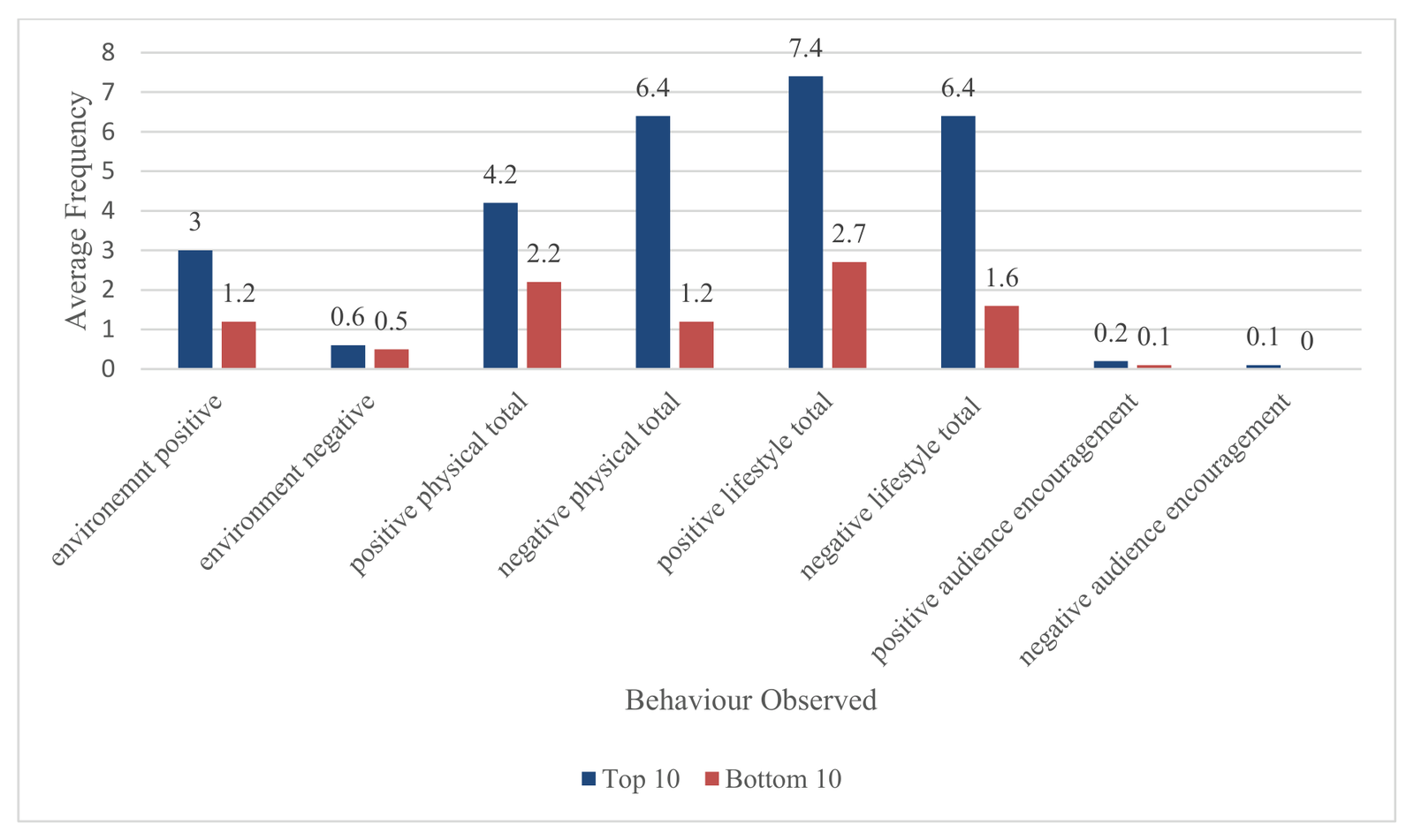
| 4.2 | 2.7 | |||
|---|---|---|---|---|
| 2.2 | ||||
| 1.2 0.6 0.5 | 1.2 | |||
| 1.6 |
Discussion
Differences Between Players and Health Behaviours (RQ1)
The Study 1 results indicated that esports players utilise a higher number of health behaviours than other player types; however, simultaneously they experience higher levels of negative outcomes and behaviours. The reported levels of negative outcomes in esports players were similar to those reported by DiFrancisco-Donoghue and colleagues (2019) study of 65 college esports players. Large percentages of esports players did not use any of the health behaviours outlined in Study 1; in some cases, over 50%. This is an alarming percentage of the professional gaming population not engaging in protective practices. It appears the guidelines of office workers, traditional sports, and poker players are not commonly used, and potentially do not completely protect esports players. This is likely due to players performing over three times as many upper body movements a minute compared to office workers (McGee & Ho, 2021), as well as experiencing many of the same pressures that traditional athletes face (Leis et al., 2022). Esports players reported accessing physiotherapists more often than streamers and recreational players; however, esports players still experienced more negative physical outcomes. This contradiction may potentially be due to the lack of standardised assessment and treatment of gaming injuries (DiFrancisco-Donoghue et al., 2019). Furthermore, unlike traditional sports, there is yet to be a uniform anti-doping organisation esports wide, with dispersed organisations and policies being the only safeguards for players (Frias, 2022). These results highlight the need for esports appropriate guidelines to address the physical and mental pressures esports players are under from the amount of gaming needed to work in the industry. While both recreational players and streamers perform fewer health behaviours than esports players, they were also less likely to encounter negative outcomes. However, the percentage of these players that were exposed to negative aspects of gaming were still significant (See Appendix A), especially considering esports players generally gamed for longer periods. This implies there is a portion of the population who are vulnerable and need to utilise more health behaviours to reduce negative outcomes occurring.Potential methods to promote health behaviours to these populations are discussed in RQ2r. The IPAQ showed no differences between player type and physical exercise, both through the IPAQ levels and MET scores. The significance threshold was barely exceeded; a bigger esports player sample could be found significant. This would support Bihari and Pattanaik’s (2023) report that exercise is part of elite esports player physical training.
Using and Noticing Health Behaviours in Public (RQ2)
Professional players self-reported talking about or performing health behaviours in public at a higher rate than recreational players noticing. This could be explained by a nuance to some health behaviours professionals use and recreational players not noticing them, such as specific exercises or break patterns. Step-1 of social learning theory is attention; for role-modelling to occur, one must be able to observe and understand a behaviour (Bandura & Walters, 1977). If recreational players cannot identify or understand the behaviour being modelled to them, they cannot replicate it. Another explanation could be that recreational players do notice behaviours, but do not have the same equipment as professionals, and cannot replicate the behaviour, as per step 3: production (Bandura & Walters, 1977). Finally, professionals may view themselves as role-models and believe that they act accordingly, however, this is not the reality observed. It could be that the monetary gain from promoting products (e.g. energy drinks; blue-light glasses) is incentive for streamers to encourage their viewers. As there is nothing to gain from promoting health behaviours, professionals may be less inclined. The above reasons could explain why minimal role-modelling of health behaviours is occurring despite being effective in traditional sports (Bush et al., 2004). Furthermore, according to the health behaviour model (Janz & Becker, 1984), for behaviour change to occur a person has to: (1) perceive they are susceptible to negative outcomes unless they change, (2) perceive severity, (3) perceive benefits, (4) perceive that barriers do not outweigh the positives, (5) see cues to take action, and (6) are confident in their self-efficacy for change. Recreational players may not be knowledgeable enough regarding the first four factors, and if professionals talked about health behaviours and negative outcomes (in a non-biased manner, e.g., not stating “gaming=bad”), behaviour change and role-modelling could increase.
Streamer Professionality and Health Behaviours (H1)
Study 2 supported H1 as the regression and t-tests indicated higher health behaviours in higher streamers who had larger subscriber and revenue bases (i.e., more ‘professional’). This further supports the disparity between professionals and recreational players found in RQ1. Only negative hand significantly predicted professionality in the regression; this was likely due to the limited sample size. When comparing top 10 and bottom 10 streamers, the top 10 performed more health behaviours, but also more negative behaviours and outcomes. This further supports the results from Study 1.
Study 2 also highlights another reason why role-modelling was found to be ineffective: regardless of streamer level, rarely did streamers encourage their audience to perform a health behaviour (Figure 1). This finding further shows the relevance of social learning theory (Bandura & Walters, 1977) in that recreational players may not be aware of the health behaviours of professionals, and thus are unable to be susceptible to role-modelling. Further research with a bigger sample could highlight whether limited audience encouragement is a streamer-wide trend and whether encouraging health behaviours to audiences can increase role-modelling.
Overall, the results indicate differences in the way types of players approach health and their gaming behaviours. It appears esports players are aware of the negative outcomes from over-gaming and attempt to counteract them with higher frequency of health behaviours. However, they still experience greater negative outcomes. While recreational players and streamers utilised fewer health behaviours and experienced fewer negative outcomes, they were still a vulnerable population at risk of negative outcomes. Unlike traditional sports (Bush et al., 2004; Gabriel et al., 2019; White et al., 2016), video game professionals do not appear as successful role-models to recreational players. Emphasising health behaviours in professional players could improve their health, as well as their audience if effective role-modelling can occur. Future research should focus on role-modelling to effectively foster behavioural change in the gaming industry.
Strengths and Limitations
Our project addresses many gaps in the literature and is the first study to compare the health behaviours and health outcomes for esports, streamers, and recreational players. Further, this study was the first to use behavioural observation in professional gaming to measure their behaviours firsthand, exploring role-modelling in the professional gaming context. Studies have largely focused on how the content (e.g., violence) of video games affect recreational players; this is one of few studies that explores the relevance of positive role-modelling by professional players with a platform to do so. Use of established health models from similar industries strengthens the legitimacy of the behaviours and outcomes explored in this study and could act as a baseline for the esports industry in creating appropriate regulations for esports players. The global scope also gave a broader understanding of the health behaviours of players throughout the world. The self-reported nature of the survey may have margins for measurement error, such as overinflation of positive traits. Many bot/troll/AI responses were removed from the dataset; some may have been missed, reducing reliability. Other comparative models that fit the gaming population could exist that were overlooked; further health behaviours could arise from future studies if they were to find this. However, future studies should develop more gaming-specific scales and measures to better contextualise a growing population, and to avoid having to adapt behaviours from similar contexts (office jobs, traditional sports, poker players). Language or cultural barriers may have impacted the ability of some participants to understand definitions and terminology. Last, few full-time streamers and esports players completed the survey, which limited analysis on elite esports player behaviour; future studies could explore this.
Theoretical and practical implications
Our results imply that gaming professionals are not adequately role-modelling health behaviours, and/or recreational players are not cognisant or cannot recognise which positive behaviours to adopt in their own gaming. There could also be barriers in the gaming industry or medium of delivery that is preventing effective role-modelling. This could imply the mechanisms of social learning theory need recontextualisation with new media and technology. The theory was developed in the 70’s before technology and digital breakthroughs revolutionised the landscape of the modern workforce. This study brings to attention the need to continually evolve and adapt established theory to fit the context of the current climate. Further research should continue to explore role-modelling in the gaming scene, and how it can effectively be implemented. The results bring to question the platform people have in the esports industry and whether they have a duty of care to their audience and workers. Currently, gaming professionals do not act as role-models for health behaviours, but they have proven that they can effectively endorse products (e.g., energy drinks and blue light glasses), calling into question the level of obligation that the esports industry has on the health of its players, as well as the fans who support it. Traditional college sports have extensive health guidelines with doctors to manage player workloads and injuries (Padilla & Baumer, 1994). However, similar resources are not offered to college esports players (DiFrancisco-Donoghue et al., 2019), despite research indication of esports-related injuries. If both the industry and its superstars are anything like traditional sports, the implications are that the industry could be doing more for professional players health, but further, professional players could be using their influence to increase health behaviours for themselves and fans alike.
Conclusion
We asked different types of gamers about their behaviours while gaming, and watched streamers to observe what behaviours they use. Ultimately, with gaming becoming ever popular, the health of players should be at the forefront of the industry to boost player welfare as well as performance and longevity. Regulations need to be created for professionals, and methods to educate recreational players should be further researched. This study can assist in developing guidelines by showing where players are lacking in health behaviours and which negative outcomes are most common. Placing emphasis on player health will help further legitimise the growing esports industry.
References
- Akoglu, H. (2018). User's guide to correlation coefficients. Turkish Journal of Emergency Medicine, 18. https://doi.org/10.1016/j.tjem.2018.08.001
- American Psychiatric Association. (2013). Diagnostic and statistical manual of mental disorders : DSM-5 (Fifth edition. ed.). Washington, D.C. : American Psychiatric Publishing. https://doi.org/10.1176/appi.books.9780890425596
- Bandura, A., & Walters, R. H. (1977). Social learning theory (Vol. 1). Englewood cliffs Prentice Hall.
- Bihari, I., & Pattanaik, D. (2023). Professional Gaming and Pro-Gamers: What Do We Know So Far? A Systematic Review. Games and Culture, 0(0). https://doi.org/10.1177/15554120231154058
- Burke, B., & Lucier-Greer, M. (2021). Comparing video game engagement measures as related to individual and relational well-being in a community sample of adult gamers. Computers in Human Behavior Reports, 4, 100136. https://doi.org/10.1016/j.chbr.2021.100136
- Bush, A. J., Martin, C. A., & Bush, V. D. (2004). Sports Celebrity Influence on the Behavioral Intentions of Generation Y. Journal of Advertising Research, 44(1), 108-118. https://doi.org/10.1017/S0021849904040206
- Chaput J. P. (2014). Sleep patterns, diet quality and energy balance. Physiology & behavior, 134, 86–91. https://doi.org/10.1016/j.physbeh.2013.09.006
- Craig, C. L., Marshall, A. L., Sjöström, M., Bauman, A. E., Booth, M. L., Ainsworth, B. E., Pratt, M., Ekelund, U., Yngve, A., Sallis, J. F., & Oja, P. (2003). International physical activity questionnaire: 12-country reliability and validity. Med Sci Sports Exerc, 35(8), 1381-1395. https://doi.org/10.1249/01.Mss.0000078924.61453.Fb
- Demetrovics, Z., Urbán, R., Nagygyörgy, K., Farkas, J., Zilahy, D., Mervó, B., Reindl, A., Ágoston, C., Kertész, A., & Harmath, E. (2011). Why do you play? The development of the motives for online gaming questionnaire (MOGQ). Behavior research methods, 43(3), 814–825. https://doi.org/10.3758/s13428-011-0091-y
- DiFrancisco-Donoghue, J., Balentine, J., Schmidt, G., & Zwibel, H. (2019). Managing the health of the eSport athlete: an integrated health management model. BMJ open sport & exercise medicine, 5(1), e000467. http://dx.doi.org/10.1136/bmjsem-2018-000467
- Epp, A. M., Dobson, K. S., & Pusch, D. (2012). Psychopathology: Diagnosis, Assessment, and Classification. In V. S. Ramachandran (Ed.), Encyclopedia of Human Behavior (Second Edition) (pp. 225-233). Academic Press. https://doi.org/https://doi.org/10.1016/B978-0-12-375000-6.00294-9
- Franks, R. R., King, D., Bodine, W., Chisari, E., Heller, A., Jamal, F., 4th, Luksch, J., Quinn, K., Singh, R., & Solomon, M. (2022). AOASM Position Statement on Esports, Active Video Gaming, and the Role of the Sports Medicine Physician. Clinical journal of sport medicine : official journal of the Canadian Academy of Sport Medicine, 32(3), e221– e229. https://doi.org/10.1097/JSM.0000000000001034
- Frias, F. J. L. (2022). The “big red bull” in the esports room: Anti-doping, esports, and energy drinks. Performance Enhancement and Health, 10(1), Article 100205. https://doi.org/10.1016/j.peh.2021.100205
- Gabriel, E. H., Hoch, M. C., & Cramer, R. J. (2019). Health Belief Model Scale and Theory of Planned Behavior Scale to assess attitudes and perceptions of injury prevention program participation: An exploratory factor analysis. Journal of science and medicine in sport, 22(5), 544–549. https://doi.org/10.1016/j.jsams.2018.11.004
- Gochman, D. S. (1997). Handbook of health behavior research (Vol. 1-4). Plenum. Granic, I., Lobel, A., & Engels, R. C. (2014). The benefits of playing video games. American psychologist, 69(1), 66–78. https://doi.org/10.1037/a0034857
- Griffiths, M., King, D., & Demetrovics, Z. (2014). DSM-5 internet gaming disorder needs a unified approach to assessment. Neuropsychiatry, 4(1), 1-4. https://doi.org/10.2217/npy.13.82
- Halson, S. L. (2008). Nutrition, sleep and recovery. European Journal of Sport Science, 8(2), 119-126. https://doi.org/10.1080/17461390801954794
- Hanna, F., Daas, R. N., El-Shareif, T. J., Al-Marridi, H. H., Al-Rojoub, Z. M., & Adegboye, O. A. (2019). The relationship between sedentary behavior, back pain, and psychosocial correlates among university employees. Frontiers in public health, 7, 80. https://doi.org/https://doi.org/10.3389/fpubh.2019.00080
- Heaney, S., O'Connor, H., Michael, S., Gifford, J., & Naughton, G. (2011). Nutrition knowledge in athletes: a systematic review. International journal of sport nutrition and exercise metabolism, 21(3), 248–261. https://doi.org/10.1123/ijsnem.21.3.248
- Janz, N. K., & Becker, M. H. (1984). The Health Belief Model: a decade later. Health education quarterly, 11(1), 1–47. https://doi.org/10.1177/109019818401100101
- Kim, H.-J., Hong, J.-I., Mok, H.-J., & Lee, K.-M. (2012). Effect of Workplace-Visiting Nutrition Education on Anthropometric and Clinical Measures in Male Workers. cnr, 1(1), 49-57. https://doi.org/10.7762/cnr.2012.1.1.49
- Knapik J. J. (2015). The importance of physical fitness for injury prevention: part 1. Journal of special operations medicine : a peer reviewed journal for SOF medical professionals, 15(1), 123–127.
- Leis, O., Lautenbach, F. ., Birch, P. D., & Elbe, A.-M. (2022). Stressors, associated responses, and coping strategies in professional esports players: A qualitative study. International Journal of Esports, 1(1). Retrieved from https://www.ijesports.org/article/76/html
- Li, Y., Wang, C., & Liu, J. (2020). A systematic review of literature on user behavior in video game live streaming. International Journal of Environmental Research and Public Health, 17(9), 3328. https://doi.org/10.3390/ijerph17093328
- McCormack, A., & Griffiths, M. D. (2012). What Differentiates Professional Poker Players from Recreational Poker Players? A Qualitative Interview Study. International Journal of Mental Health and Addiction, 10(2), 243-257. https://doi.org/10.1007/s11469-011-9312-y
- McGee, C., & Ho, K. (2021). Tendinopathies in video gaming and esports. Frontiers in Sports and Active Living, 3, 689371. https://doi.org/10.3389/fspor.2021.689371
- Micallef, D., Parker, L., Brennan, L., Schivinski, B., & Jackson, M. (2022). Improving the Health of Emerging Adult Gamers-A Scoping Review of Influences. Nutrients, 14(11), 2226. https://doi.org/10.3390/nu14112226
- Migliore, L. (2021). Prevention of Esports Injuries. In Handbook of Esports Medicine: Clinical Aspects of Competitive Video Gaming (pp. 213-240). Springer. https://doi.org/10.1007/978-3-030-73610-1
- Munsamy, A. J., Moodley, M., Khan, Z., Govender, K., Nkwanyana, M., Cele, S., & Radebe, M. (2022). Evidence on the effects of digital blue light on the eye: A scoping review. African Vision and Eye Health, 81(1), 9. https://doi.org/10.4102/aveh.v81i1.685
- Padilla, A., & Baumer, D. (1994). Big-time college sports: Management and economic issues. Journal of Sport and Social Issues, 18(2), 123-143. https://doi.org/10.1177/019372394018002003
- Pollack, C. C., Kim, J., Emond, J. A., Brand, J., Gilbert-Diamond, D., & Masterson, T. D. (2020). Prevalence and strategies of energy drink, soda, processed snack, candy and restaurant product marketing on the online streaming platform Twitch. Public Health Nutrition, 23(15), 2793-2803. https://doi.org/10.1017/S1368980020002128
- Porter, G., Starcevic, V., Berle, D., & Fenech, P. (2010). Recognizing problem video game use. The Australian and New Zealand journal of psychiatry, 44(2), 120–128. https://doi.org/10.3109/00048670903279812
- Poulus, D. R., Coulter, T. J., Trotter, M. G., & Polman, R. (2022). Longitudinal analysis of stressors, stress, coping and coping effectiveness in elite esports athletes. Psychology of Sport and Exercise, 60 (1), 102093. https://doi.org/10.1016/j.psychsport.2021.102093
- Rodrigues, M. S. A., Leite, R. D. V., Lelis, C. M., & Chaves, T. C. (2017). Differences in ergonomic and workstation factors between computer office workers with and without reported musculoskeletal pain. Work, 57, 563-572. https://doi.org/10.3233/WOR-172582
- Saunders, T. J., McIsaac, T., Douillette, K., Gaulton, N., Hunter, S., Rhodes, R. E., Prince, S. A., Carson, V., Chaput, J.-P., & Chastin, S. (2020). Sedentary behaviour and health in adults: an overview of systematic reviews. Applied Physiology, Nutrition, and Metabolism, 45(10), S197-S217. https://doi.org/10.1139/apnm-2020-0272
- Schary, D. P., Jenny, S. E., & Koshy, A. (2022). Leveling Up Esports Health: Current Status and Call to Action. International Journal of Esports, 1(1). https://www.ijesports.org/article/70/html
- Sohrabi, M. S., & Babamiri, M. (2022). Effectiveness of an ergonomics training program on musculoskeletal disorders, job stress, quality of work-life and productivity in office workers: a quasi-randomized control trial study. International journal of occupational safety and ergonomics : JOSE, 28(3), 1664–1671. https://doi.org/10.1080/10803548.2021.1918930
- Thomas, D. T., Erdman, K. A., & Burke, L. M. (2016). American College of Sports Medicine Joint Position Statement. Nutrition and Athletic Performance. Medicine and science in sports and exercise, 48(3), 543–568. https://doi.org/10.1249/MSS.0000000000000852
- United States Department of Labor. (n.d.). Compter Workstations eTool. United States Department of Labor. https://www.osha.gov/etools/computer-workstations/checklists/evaluation
- White, P., Donaldson, A., & Finch, C. F. (2016). But can someone like me do it? The importance of appropriate role-modelling for safety behaviours in sports injury prevention. British journal of sports medicine, 50(10), 569–570. https://doi.org/10.1136/bjsports-2015-095105