A COMPARATIVE ANALYSIS OF TOP EARNING FEMALE AND MALE ESPORTS PLAYERS: ASSESSING SOCIAL MEDIA ACTIVITY
by Colleen Dibble*, Mark Nagel, Wil Fisackerly, Stephen ShapiroEmail: dibblec@email.sc.edu
Received: 22 Jul 2024 / Published: 20 Nov 2025
Abstract
Aims: The aim of this study was to compare social media engagement of the top-earning male and top-earning female esports players to determine if social media engagement relates to competition earnings and differs based upon gender.
Methods and Results: Eighty-one top earning esports players, the top earning forty-one females and the top earning forty males, were chosen as the sample size for this study. The players’ social media followers on the platform Twitter were analyzed. Results indicated that the top-earning male players earn significantly more than the top-earning female players; however, the top female earning esports professionals often have a greater number of social media followers and rates of engagement than their top-earning male counterparts.
Conclusions: The study indicated that the top female esports professionals earn $3.2 million dollars in tournament earnings less then male esports players during the period of analysis, confirming previous research and anecdotal evidence that females are severely underrepresented on the top performing teams and in the highest earning tournaments. However, despite earning much lower overall prize money, numerous top female esports players have a large social media following that often surpasses many of the male top earning esports players, indicating that potentially powerful marketing opportunities exist if brands utilize top-earning female esports professionals. Future studies should analyze the public reaction to top-earning female professionals in other areas of their non-performance life (sponsorship, public appearances, etc.) to determine if such players have a similar or potentially greater impact than their male counterparts.
Introduction
Esports is a competitive industry that includes online gaming, cyber sport, and virtual sport (1). In the past 30 years, esports have experienced significant growth. Professional esports competitions now often attract a large global audience, with millions of dollars at stake in some tournaments. In addition to players earning salaries and prize pools in professional settings, some colleges have offered scholarships that provide financial support as well as formal training and competition opportunities to students to compliment their higher education pursuits (2). Networks such as ABC, ESPN, and TBS have broadcasted prominent esports tournaments and other esports-related content (3). The esports industry reached $1.22 billion in 2021 and is projected to expand further over the next decade (4). The industry is growing in many facets, including spectatorship via both streaming and in-person attendance. Furthermore, sponsorship has played a significant role in contributing to large tournament prize pools as well as providing ongoing support for many players and teams (5). However, despite the extensive economic activity across a variety of areas, comprehensive data indicating how esports players earn money, especially outside tournament winnings, is often lacking. While there is comprehensive prize pool data available on websites such as Esports Earnings, individual earnings (e.g., sponsorship) of esports players outside of tournament winnings is typically not publicly available, nor tracked on Esports Earnings (6). To date, there is also a drastic tournament and employment gender pay gap between male and female esports players. Thus, this research is looking strictly at tournament earnings and the gap of tournament earnings between male and female esport players.
In 2023, this gap was evident as only one female (Sasha Hostyn) ranked within the top 500 prize winners (6). 99% of the top 500 esports earners are male, with a large percentage of those players competing in Dota 2 tournaments. The specific earning gap was approximately $6.4 million dollars between the top earning male esport player, and top earning female esport player. According to Statistica, 25% of Dota 2 identify as female, which could contribute to the lack of female participation in Dota 2 tournaments – which are the highest prize pool playing tournaments to date (7). Further, the top tournament earning female esport players #1 - #500 do not play Dota 2. In fact, the first female did not play in the International (Dota 2’s largest tournament), until 2021 (8). It is important to note that as literature highlights, while game skill is undoubtedly essential for competition success, research also highlights the influence of external barriers such as tournament accessibility, sponsorship opportunities, and structural sexism.
It is important to note that the difference in game titles of top tournament earning esport players related to their tournament earnings is the obvious assumption. Additionally, it is easy to assume that male esport players are participating in high paying tournaments, which earn more the most prize money, creating their influx in the top tournament-earning esports players list. This study wants to look beyond the prize money, at who these players are, and if females are in fact earning less than their male counterparts, what are they doing to sustain an income. Furthermore, there is a wealth of literature investigating the motivators for esports players and their participation in game play, industry structure, the hostile and sexist online environment, in-game female representation and other issues (9). The gap in the literature is that studies rarely go beyond the gaming environment of esport players.
It is important to note that there may be structural barriers or environmental hindrances for females in many aspects of the gaming environment. However, the social media landscape in which competitive gaming offers an opportunity for female esports players to fully engage with their fans without any need to be directly or indirectly supported by fellow players, team owners, tournament organizers, etc. Although the social media environment has far fewer barriers to participation by females, little is known how female gamers leverage social media to advance their careers and how the public reacts to those players. Given the open nature of social media engagement, it is crucial to examine both the actions of prominent esports professionals in this realm and those who follow and interact with these players.
By connecting with fans through social media, esports players can strengthen their personal brand and generate income through advertising revenue as well as direct financial support from fan donations. Platforms like Twitch have enabled esports players to generate income from subscribers. Meanwhile, Twitter (X) has emerged as a central medium for both esports’ players and their fans (10). Additionally, Twitter (X) provides a viable platform for measuring social media engagement, as it offers real-time data concerning both professional esports players and content creators or influencers who are individuals who often do not compete in major tournaments but maintain a substantial online following for their esports and non-esports related content creation. It is worth noting that some content creators can be just as, if not more, popular than professional esports players, despite earning less money from "competitive" activities.
The purpose of this study is to investigate both the pronounced gender wage gap and the potential influence of social media in the esports industry. We will analyze data through the lens of social identity theory. Introduced by scholars Tajefel and Turner, social identity theory supports groups which people belong to (e.g., esports community, game title community), and advances an individual’s pride and sense of belonging (11). By categorizing people in groups, prejudice and stereotypes may be present. For example, female esports players’ gameplay ability may be mocked because they are not in the group of top earning players overall, nor play game titles with high tournament payouts. Social identity reflects how players define themselves within their groups.
Additionally, this study recognizes player power, as the ability for esports players to influence the esports ecosystem, not only in game play, but also player power in fan engagement. We note that most of the past research has been on male esport players, leaving female esports players largely ignored. Rogstad conducted a literature review of gender and esports, utilizing the theoretical framework of hegemonic masculinity to understand gender inequalities in esport, noting the link between esports and traditional sport, calling for additional research on how masculinity remains dominant in the esport ecosystem even though there are many women participating in esports (12).
Our assessment of tournament earnings confirms Rogstad’s findings that women esports players are discouraged from progressing as competitive players because of sociological (harassment and toxicity) and structural (not many females play top paying tournament game titles) limitations.
According to Kordykaka, female esports players have a higher perceived stress level and lower self-report scores than male esports players, which could contribute to why female esport players do not play certain game titles (e.g., Dota 2) (13). Kordykaka recognizes that female esport players are underrepresented at the highest levels (e.g., The International Dota 2 Tournament) of esports. We acknowledge that esports tournament earnings data indicates there is a clear and wide disparity of tournament earnings between top male and female esports players. What we found interesting is the variable of social media followers of these top tournament earning esports players. Thus, this study focused on top tournament earning male and female esports players’ social media activity, specifically social media engagements on the social media platform Twitter (X).
Examining the extent of social media engagement among esports players can provide valuable insight as it is a prominent communication platform within the industry. Additionally, understanding the timing and way esports players utilize social media can enhance the understanding of sponsors and industry leaders. While existing literature predominantly concentrates on topics such as masculinity, online harassment, and gender expectations within the esports realm, it is essential to conduct further investigations into the involvement of female esports players and their online activities. The first step in this analysis is to acknowledge that social media plays a significant role in the esports ecosystem, offering players an avenue to engage with fans independently, without relying on coaches, owners, or other stakeholders.
Methodology
To examine the utilization of social media among the highest-earning esports players, a quantitative analysis was conducted. Prior to collecting data, research questions were formulated with the aim of understanding how female esports players in the top tournament-earning bracket leverage social media. The research questions are listed below:
RQ1: What is the relationship between top esports’ players social media engagement and earnings from tournament competition?
RQ2: Are top tournament-earning female esports professionals as likely to have social media followings as the top tournament-earning male professionals?
The research design utilized descriptive statistics and correlation analysis to determine a way to answer RQ1 and RQ2. Secondary data was utilized to determine the top earning male and female esports players and their overall tournament earnings, social media activity and engagement with followers.
Data Collection
Ranking data from Esports Earnings, a publicly available online database with information on 100 games with verified monetary prizes, was collected. Games featured in the tournament earnings rankings include Dota 2, Rocket League, League of Legends, Hearthstone, Fortnite, Conter-Strike: Global Offensive, etc. (2). Since tournament earnings in esports vary over time, a single data snapshot was collected on November 7, 2022. Currently, Esports Earnings is the most accurate, public database in the esports community.
A sample of the top earning esports players was collected including the top 40 male esports players (n=40) and top 41 female players (n=41) for a total sample of 81 players (N = 81). Forty-one female esports players were chosen in the dataset because at the time of collection, two players shared one place in the ranking. Additional demographic data and total tournament prize pool earnings were collected.
After collecting overall tournament earnings for the 81 players on Esports Earnings.com, the players’ social media accounts on the following platforms: Facebook, Twitter (X), You Tube, Instagram, Twitch and Tik Tok were recorded to determine which platform had the greatest participation by the top earning players. Twitter (X) was the chosen platform for the next phase of analysis as it was 62% utilized by all esports players in the sample. Table 1.1 and Table 1.2 provide information regarding the studied esports professionals and their Twitter (X) activity.
Table 1.1 Top Tournament-Earning Male Esports Players| Last | First | Ranking | Earnings | Highest Paying Game | Followers | Posts | Avg. Likes | Engage Rate | ||||||||
|---|---|---|---|---|---|---|---|---|---|---|---|---|---|---|---|---|
| Sundstein | Johan | 1 | $7,184,163.05 | Dota 2 | 317,300 | 559 | 13,565 | 4.80% | ||||||||
| Vainkka | Jesse | 2 | $6,486,948.78 | Dota 2 | 171,600 | 80 | 7,617 | 4.80% | ||||||||
| Pham | Anthan | 3 | $6,024,411.96 | Dota 2 | 123,800 | 6 | 71,608 | 11.30% | ||||||||
| Debs | Sebastien | 4 | $5,823,909.40 | Dota 2 | 233,600 | 448 | 7,623 | 3.46% | ||||||||
| Taavitsainen | Toplas | 5 | $5,690,417.57 | Dota 2 | 135,700 | 72 | 1,324 | 1.05% | ||||||||
| Takhasomi | Kuro | 6 | $5,276,347.73 | Dota 2 | 248,800 | 13 | 2,005 | 0.95% | ||||||||
| Al-Barkawi | Amer | 7 | $4,877,285.26 | Dota 2 | 267,100 | 43 | 2,090 | 0.87% | ||||||||
| Ivanov | Ivan | 8 | $4,660,359.74 | Dota 2 | 78,800 | 40 | 1,572 | 2.27% | ||||||||
| Urpalainen | Lasse | 9 | $4,532,649.04 | Dota 2 | 115,700 | 7 | 6,695 | 6.15% | ||||||||
| Merhej | Maroun | 10 | $4,274,654.27 | Dota 2 | 92,200 | 31 | 2,177 | 2.70% | ||||||||
| Naidenov | Yaroslav | 11 | $4,158,193.49 | Dota 2 | 7,208 | 8 | 2,468 | 35.83% | ||||||||
| Khertek | Alexander | 12 | $3,927,587.70 | Dota 2 | 0 | 0 | 0 | 0 | ||||||||
| Khalilov | Magomed | 13 | $3,926,103.07 | Dota 2 | 19400 | 923 | 411 | 2.06% | ||||||||
| Mulyarchuk | Ilya | 14 | $3,924,794.95 | Dota 2 | 0 | 0 | 0 | 0 | ||||||||
| Kolpakov | Mirsolaw | 15 | $3,911,891.05 | Dota 2 | 0 | 0 | 0 | 0 | ||||||||
| Hassan | Sumail | 16 | $3,880,289.31 | Dota 2 | 265,400 | 36 | 2,838 | 1.16% | ||||||||
| Wang | Chunyu | 17 | $3,772,491.07 | Dota 2 | 0 | 0 | 0 | 0 | ||||||||
| Ivanov | Clement | 18 | $3,722,566.20 | Dota 2 | 234,900 | 3 | 13,014 | 5.93% | ||||||||
| Ruida | Zhang | 19 | $3,721,496.14 | Dota 2 | 934 | 0 | 0 | 0 | ||||||||
| Yiping | Zhang | 20 | $3,707,013.66 | Dota 2 | 1,229 | 0 | 0 | 0 | ||||||||
| Giersdorf | Kyle | 21 | $3,625,574.08 | Fortnite | 1,900,000 | 590 | 6,158 | 0.32% | ||||||||
| Wåhlberg | Ludwig | 22 | $3,475,645.05 | Dota 2 | 143,900 | 38 | 1,334 | 0.98% | ||||||||
| Yao | Lu, | 23 | $3,291,414.31 | Dota 2 | 151,600 | 0 | 0 | 0 | ||||||||
| Arora | Saahil | 24 | $3,203,170.92 | Dota 2 | 82,200 | 6 | 3,196 | 1.55% | ||||||||
| Linsen | Xu, | 25 | $3,057,237.67 | Dota 2 | 0 | 0 | 0 | 0 |
| Dager | Peter | 26 | $3,045,139.05 | Dota 2 | 160,800 | 772 | 1,223 | 0.91% |
|---|---|---|---|---|---|---|---|---|
| Magnusson | Gustav | 27 | $3,001,619.62 | Dota 2 | 172,800 | 22 | 331 | 0.20% |
| Aizik | Tal | 28 | $2,738,597.84 | Dota 2 | 135,700 | 389 | 827 | 0.71% |
| Loomis | Clinton | 29 | $2,600,961.16 | Dota 2 | 177,000 | 194 | 301 | 0.19% |
| Babaev | Artour | 30 | $2,562,957.34 | Dota 2 | 651,400 | 46 | 3,309 | 0.56% |
| Liangzhi | Hu, | 31 | $2,491,595.31 | Dota 2 | 774 | 0 | 0 | 0 |
| Jaradat | Yazied | 32 | $2,378,597.84 | Dota 2 | 54,500 | 22 | 2,459 | 5.08% |
| Omar | Aliwi | 33 | $2,297,190.64 | Dota 2 | 1 | 0 | 0 | 0 |
| Nielsen | Andreas | 34 | $2,294,025.43 | Dota 2 | 153,200 | 166 | 3,164 | 2.29% |
| Wang | David | 35 | $2,242,258.31 | Fortnite | 0 | 0 | 0 | 0 |
| Rasmussen | Peter | 36 | $2,167,234.23 | CS:GO | 298,200 | 364 | 2,373 | 0.80% |
| Ling | Kurtis | 37 | $2,015,831.07 | Dota 2 | 136,500 | 237 | 868 | 0.69% |
| Peng | Li, | 38 | $2,008,582.54 | Dota 2 | 0 | 0 | 0 | 0 |
| Zeyu | Chu | 39 | $2,002,159.51 | Dota 2 | 0 | 0 | 0 | 0 |
| Højsleth | Andreas | 40 | $1,982,225.70 | CS:GO | 253,200 | 207 | 3,147 | 1.36% |
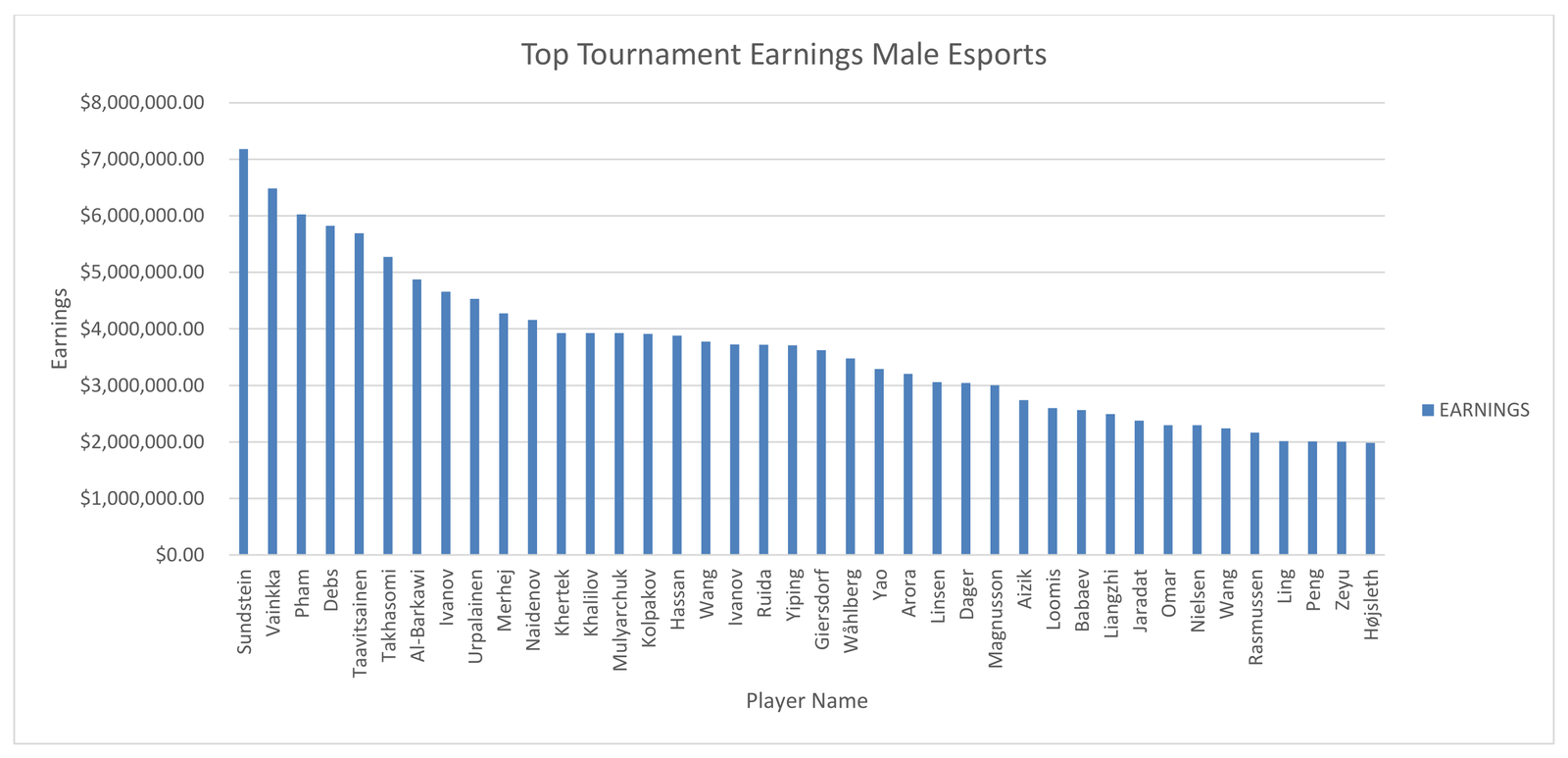 Table 1.2 Top Tournament-Earning Female Esports Players
| Last | First | Female Ranking | Earnings | Highest Paying Game | Followers | Posts | Avg. Likes | Engagement Rate | |||||||
|---|---|---|---|---|---|---|---|---|---|---|---|---|---|---|---|
| Hostyn | Sasha | 1 | $440,053.91 | Starcraft II | 39,500 | 12 | 945 | 2.71% | |||||||
| Meng | Xiao | 2 | $241,510.00 | Hearthstone | 7,850 | 7,580 | 204 | 2.79% | |||||||
| Gunn | Katherine | 3 | $122,550.00 | Multigaming | 25,600 | 1,001 | 93 | 0.39% | |||||||
| Wang | Rumay | 4 | $90,066.67 | Teamfight Tactics | 312,100 | 865 | 6,289 | 2.10% | |||||||
| Qual | Nina | 5 | $89,977.33 | Starcraft II | 6,354 | 272 | 2,295 | 83.92% | |||||||
| Ortiz | Ricki | 6 | $82,854.66 | Street Fighter V | 35,600 | 745 | 2,826 | 9.72% | |||||||
| Gabriella | Maureen | 7 | $80,869.00 | Pubg | 0 | 0 | 0 | 0 | |||||||
| Klyuenkova | Ksenia | 8 | $78,257.95 | CS:GO | 10,100 | 550 | 1,619 | 18.38% | |||||||
| Yeon | Se | 9 | $77,798.68 | Overwatch | 57,700 | 469 | 4,273 | 9.02% | |||||||
| Perez | Tina | 10 | $68,090.20 | Fortnite | 13,200 | 868 | 3,606 | 34.08% | |||||||
| Turkie | Zainab | 11 | $62,011.82 | CS:GO | 29,000 | 497 | 4,276 | 39.74% | |||||||
| Kiran | Julia | 12 | $58,681.87 | CS:GO | 64,900 | 620 | 1,701 | 2.55% | |||||||
| Rose | Janet | 13 | $55,250.00 | Fortnite | 0 | 0 | 0 | 0 | |||||||
| Novshadian | Benita | 14 | $55,189.96 | CS:GO | 20,600 | 373 | 683 | 3.05% | |||||||
| Bartell | Majorie | 15 | $55,000.00 | Dead or alive 4 | 0 | 0 | 0 | 0 | |||||||
| Hou | Yifan | 16 | $53,844.33 | Chess.com | 0 | 0 | 0 | 0 | |||||||
| Harrison | Sarah | 17 | $50,000.00 | Dead or alive 4 | 6 | 0 | 0 | 0 | |||||||
| Tran | Dian | 18 | $49,410.85 | CS:GO | 19,800 | 7 | 0 | 0 | |||||||
| Dobie | Mouria | 19 | $48,062.85 | CS:GO | 13,500 | 312 | 3,234 | 19.85% | |||||||
| Smith | Amanda | 20 | $45,830.64 | CS:GO | 16,800 | 723 | 3,288 | 28.18% | |||||||
| Harvey | Stephanie | 21 | $42,546.05 | CS:GO | 52,500 | 1,655 | 1,496 | 3.30% | |||||||
| Choe | Emma | 22 | $41,640.60 | CS:GO | 14,700 | 0 | 0 | 0 | |||||||
| Ananikova | Anna | 23 | $41,341.21 | CS:GO | 5,722 | 0 | 0 | 0 | |||||||
| NOLAST | Angelika | 24 | $40,127.33 | Call of Duty: Warzone | 15,400 | 0 | 0 | 0 | |||||||
| Le | Jennifer | 25 | $38,905.60 | CS:GO | 2,551 | 68 | 2,438 | 125.45% | |||||||
| NOLAST | Kristen | 26 | $38,700.00 | Fortnite | 238,700 | 797 | 3,804 | 1.78% | |||||||
| NOLAST | Lindsey | 27 | $36,966.01 | Apex legends | 320,700 | 1,686 | 3,070 | 0.99% | |||||||
| Anys | Imane | 28 | $36,522.51 | League of Legends | 4,200,000 | 516 | 57,685 | 1.40% | |||||||
| Cho | Rebecca | 29 | $35,850.00 | Teamfight tactics | 52,000 | 1,089 | 1,939 | 2.67% | |||||||
| Stoker | Petra | 30 | $35,785.28 | CS:GO | 17,000 | 0 | 0 | 0 | |||||||
| Chi | Christine | 31 | $35,695.25 | CS:GO | 24,700 | 320 | 3,204 | 12.07% | |||||||
| Lagno | Ekaterina | 32 | $35,298.05 | Chess.com | 0 | 0 | 0 | 0 | |||||||
| Powell | Emmalee | 33 | $35,289.84 | CS:GO | 20,100 | 632 | 718 | 3.83% | |||||||
| Lintrup | Michaela | 34 | $34,655.13 | CS:GO | 55,200 | 1,068 | 1,569 | 2.28% | |||||||
| Myddleton | Amanda | 35 | $33,516.67 | Call of Duty: MW | 182,900 | 1,027 | 3,904 | 2.68% | |||||||
| Habibi | Laurice | 36 | $33,380.84 | Apex legends | 51,000 | 517 | 465 | 0.88% | |||||||
| Krush | Irina | 37 | $32,772.00 | Lichess | 1,187 | 0 | 0 | 0 | |||||||
| Leroux- Racette | Catherine | 38 | $32,516.17 | CS:GO | 0 | 0 | 0 | 0 | |||||||
| Aquino | Jia | 39 | $32,000.00 | Hearthstone | 15,500 | 560 | 278 | 2.30% | |||||||
| Bickford | Jaime | 40 | $31,967.07 | Rocket league | 19,800 | 657 | 2,712 | 20.60% | |||||||
| Rankin | Emma | 41 | $31,556.16 | Call of Duty: Warzone | 117,500 | 979 | 3,378 | 3.55% |
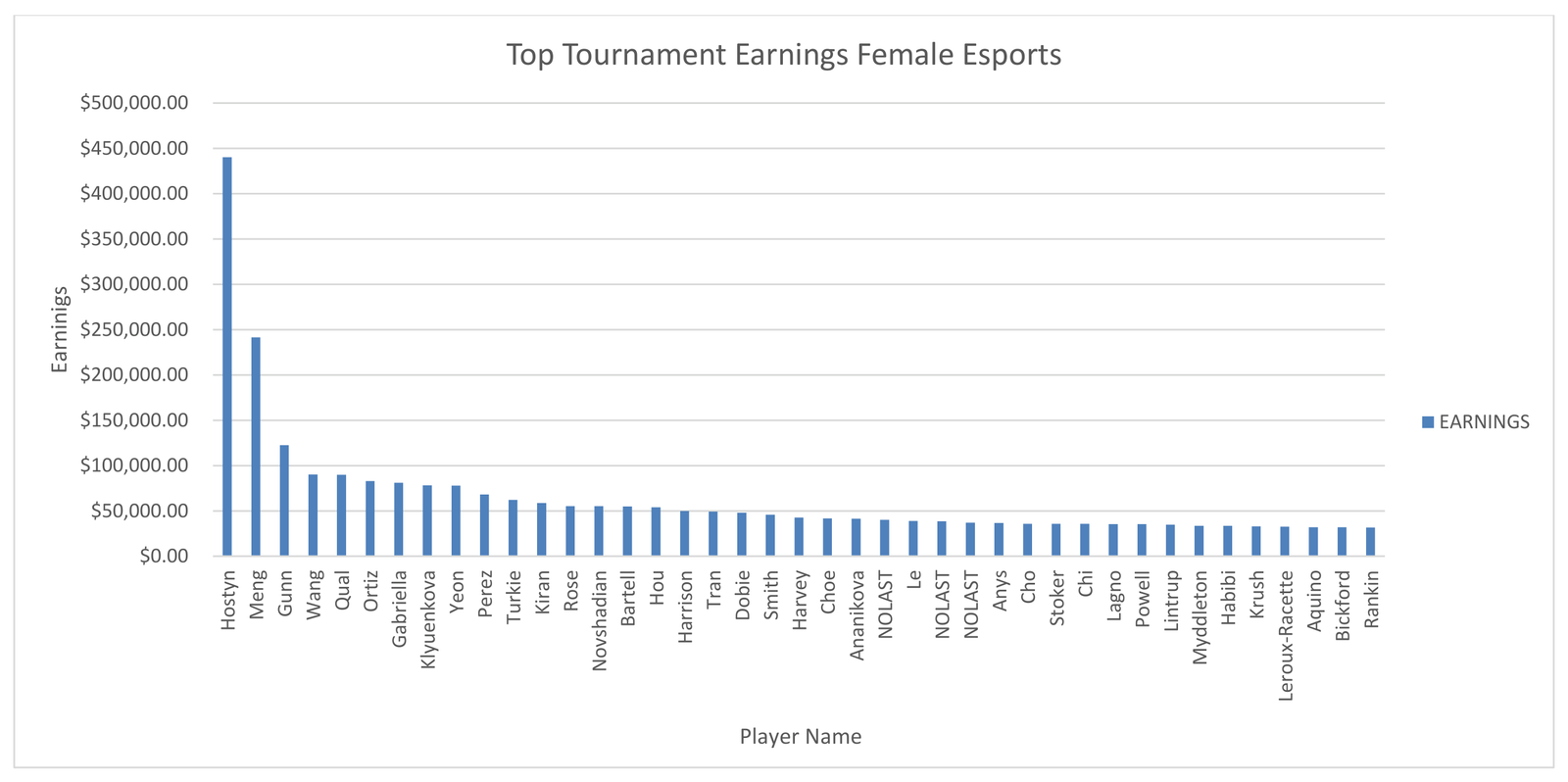 Figure 3. Top Tournament Earning Male Esports Player’ Twitter Engagement
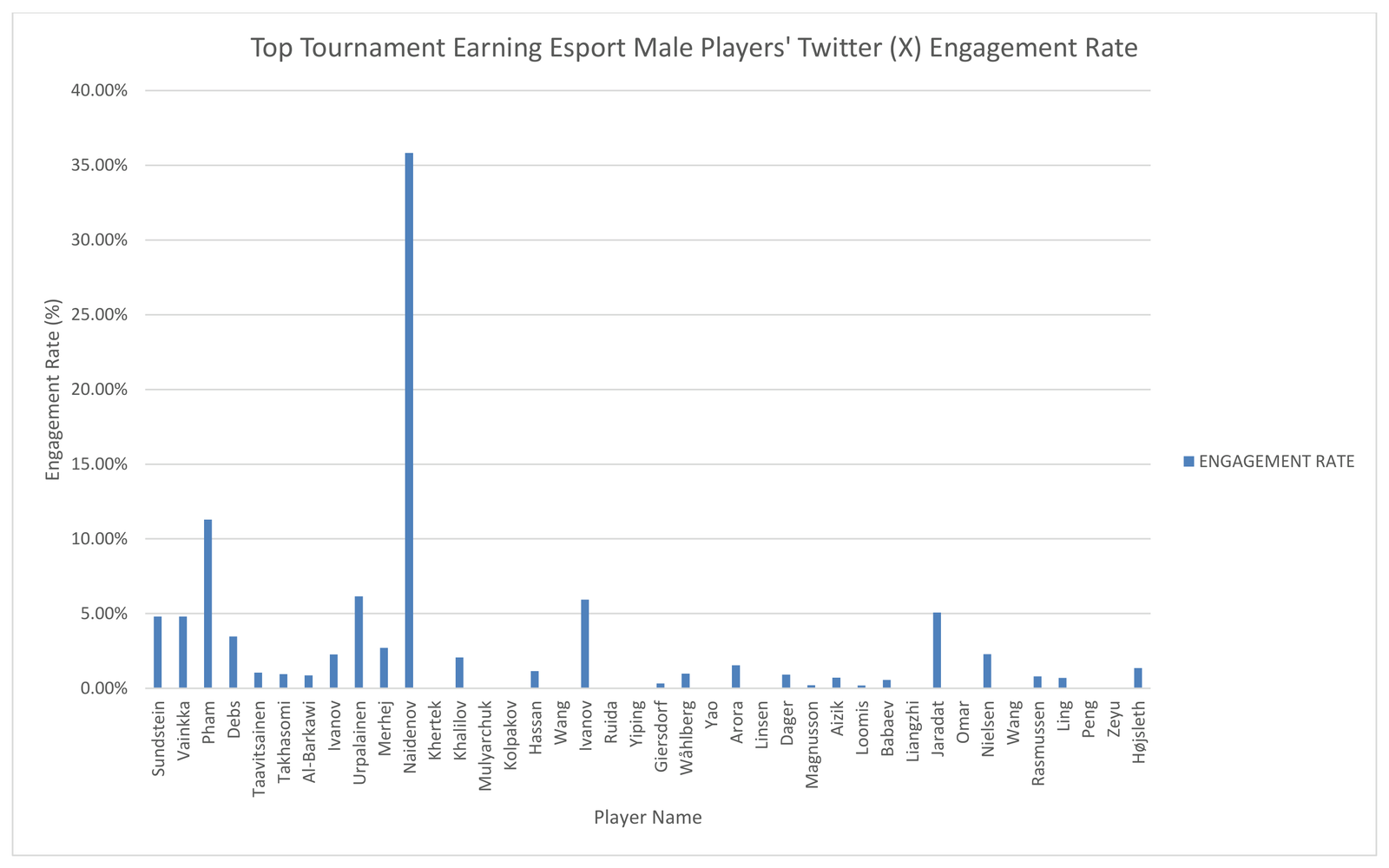 Figure 4. Top Tournament Earning Female Esports Players’ Twitter Engagement
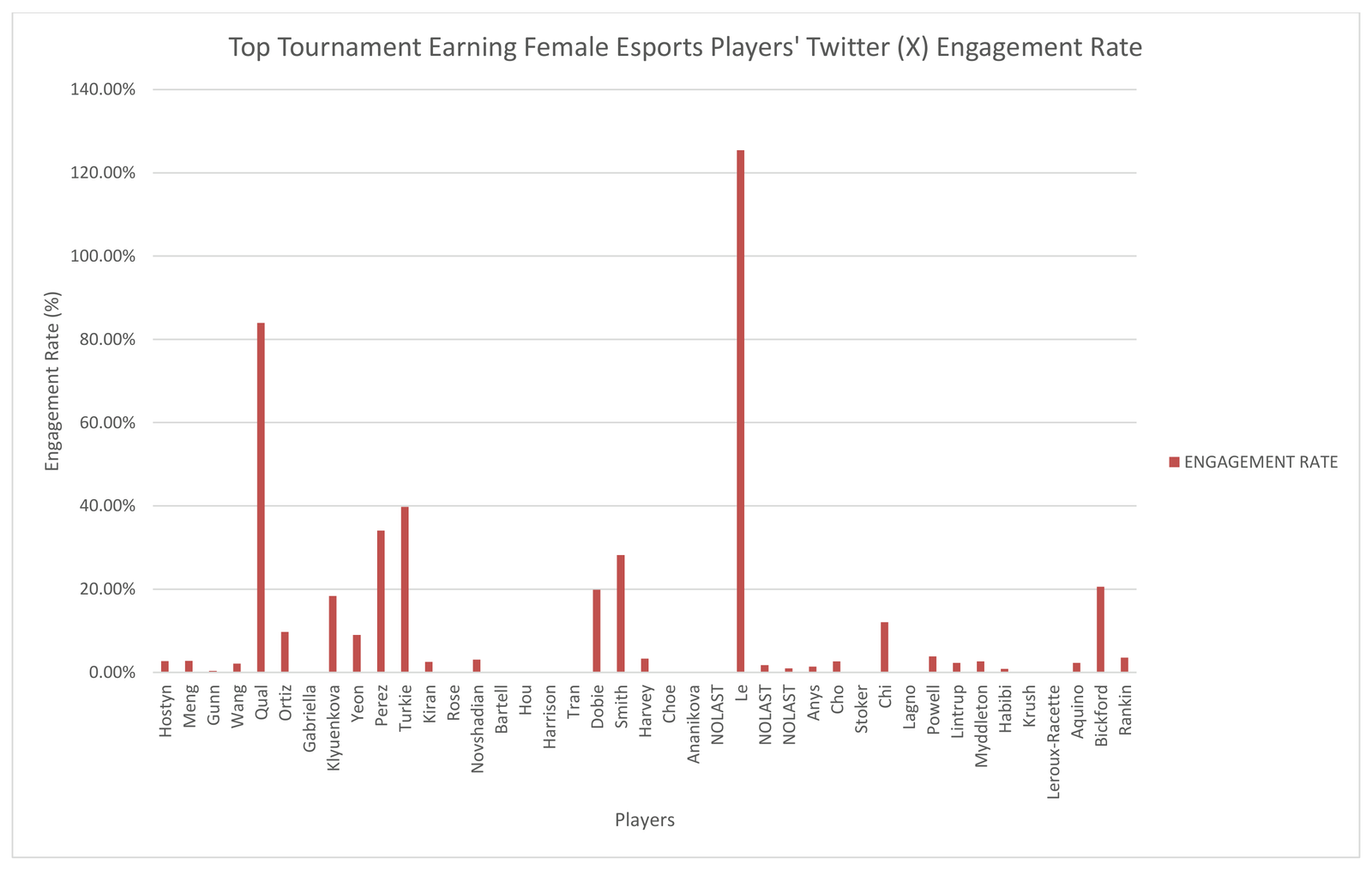 Figure 5. Top Tournament Earning Male Players Twitter (X) Followers
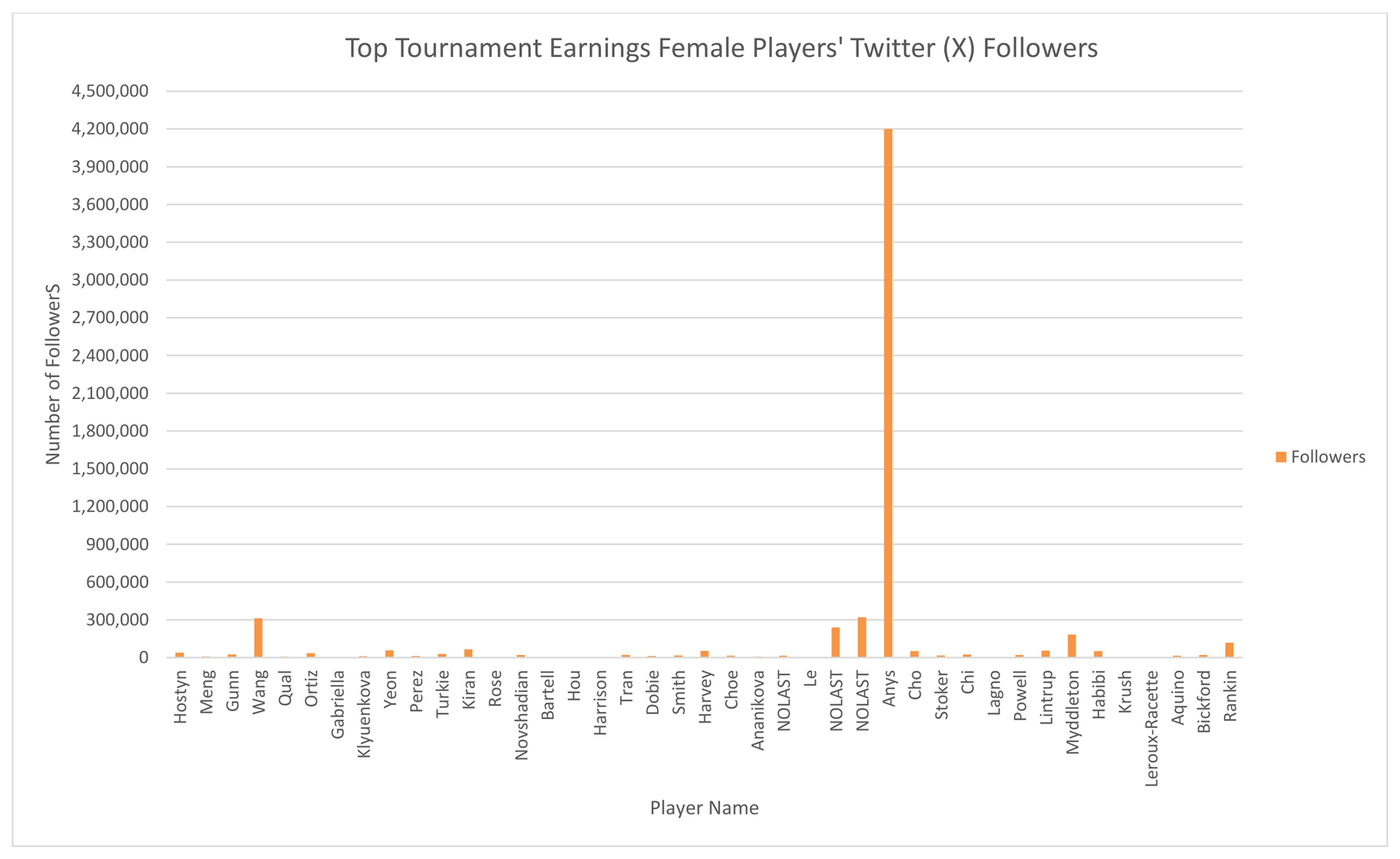
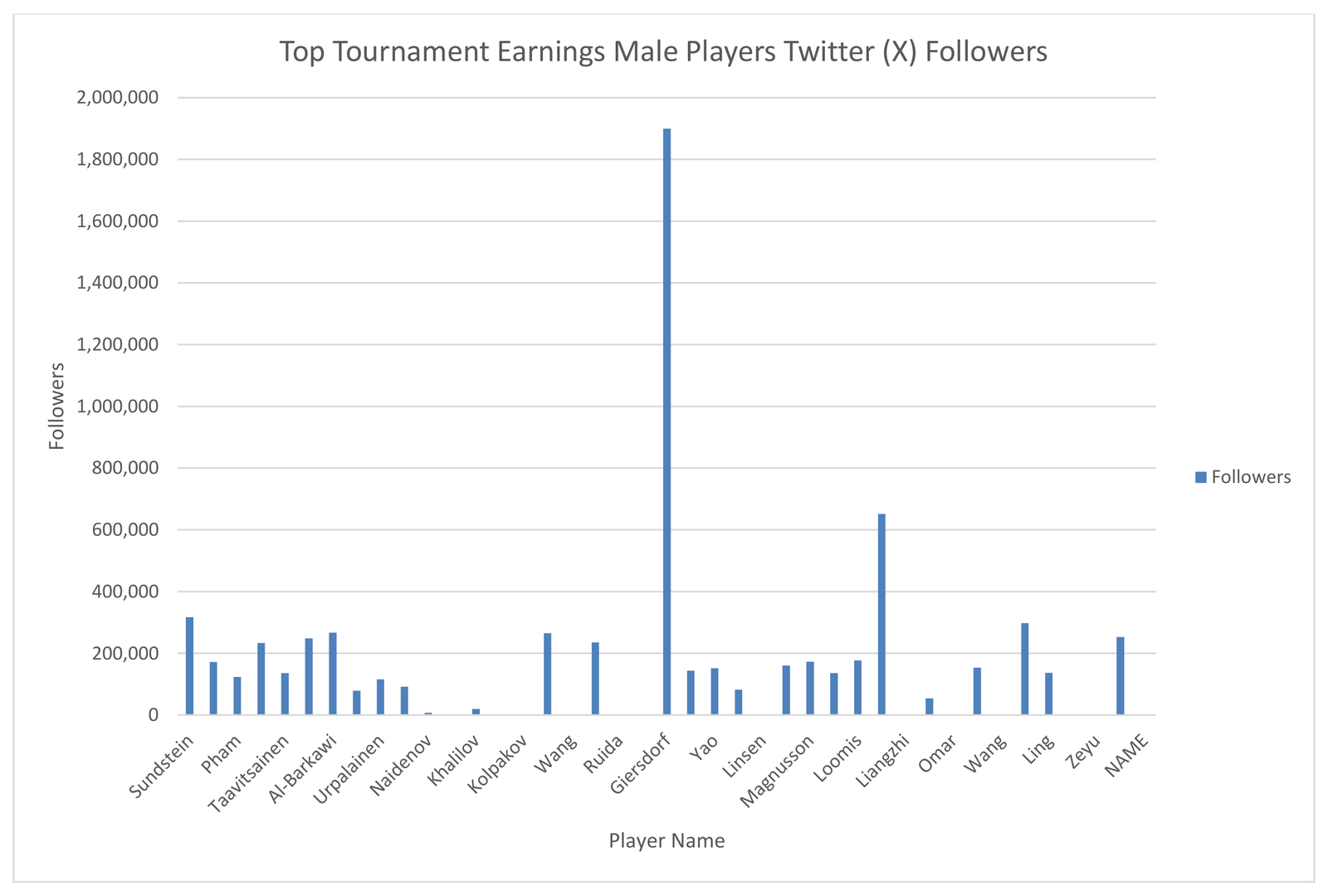 Figure 6. Top Tournament Earning Female Players’ Twitter (X) Followers
For each of the players with a Twitter (X) account, data was collected regarding their activity from December 1st, 2020, to January 1st, 2023, providing a comprehensive snapshot of social media engagement over a span of more than two years. Though it is possible that some previous tweets that appeared before the data collection occurred were removed, it is likely the number is very small. Utilizing Popsters, a social media activity data analytics tool, the data collected included number of posts (number of times the profile has posted) for each profile, average likes (indicated reactions from followers for the Twitter [X] posts), and engagement rate which is defined as how much followers engage with public posts, utilizing the following equation:
(likes+shares+comments)/count of followers = Engagement Rate (ER) (14).
This recognition of both genders’ social media activity prompted an analysis investigating the potential relationship between gender, number of followers, and earnings.
Research Design
The methodology of this study complied with the Declaration of Helsinki and adhered to institutional ethics standards. No participants were utilized in the study as data was collected from public resources. SPSS was utilized for statistical analysis.
Results
Tournament Earnings Results
Male esports players hold most of the top positions in the overall tournament earnings rankings. The highest-earning female, Sasha Hostyn, earned $440,053.91, ranking only 499th among all players. The gender wage gap disparity is substantial, confirming what many in the industry have noted and previously reported (2). An overall average of the top 40 tournament earning male ($3,649,139.78) and top 41 tournament earning female esports players’ ($64,935.18) earnings was calculated from data in Tables 1.1 and 1.2. Earnings are also displayed in Figure 1 and Figure 2. he total summary of tournament earnings for the top 41 female esports players was $2,662,342, and $145,965,591 for the 40 top male esports players. It was clear from a prize pool results that there is a gender earnings disparity. Further, it was noted in Table 1.1 that of the top 40 males, only two titles were represented: Dota 2 and Fortnite. In Table 1.2,of the top 41 females, there were 14 different titles played. In 2022, the prize pool for Dota 2 was $314,915,856 from 1,784 tournaments, making it the highest-paying prize pool for esports game titles, contributing to male esports players being the top earners overall (6). Additionally, within the top 40 male esports players and top 41 female esports players, male esports players account for 98% of overall esports earnings.
Social Media Followers Analysis
Followers were calculated from Tables 1.1 and 1.2, utilizing the top 40 male esports players and top 41 female esports players’ Twitter (X) activity and are displayed in Figure 5 and Figure 6. Of the top esports players with the most social media followers, female esports players account for nine (45%). On Twitter (X) specifically, males have a higher number of followers (6,765,446), than females (607,970). However, the engagement rate for females is much higher than males at 4.4%, with male engagement rate at .99%; this was calculated from Tables 1.1 and 1.2, displayed in Figure 3 and Figure 4 and is discussed further below. Thus, even though male esports players may have more followers, they are often less engaging, which was further shown by the total number of posts by male esports players of 5,322 compared to female esports players who had 26,465 posts. In addition, of the top 40 earning male players, 13 had not posted at all and another six had only between 1-15 posts. Conversely, the top 40 earning female players had 11 who had not posted anything and two who had between 1-15 posts.
Table 1.3 Twitter (X) Analysis Results of Top Tournament-Earning Esport Players| Esports Players | Male | Female | |||
|---|---|---|---|---|---|
| Average Engagement Rate % | 0.99% | 4.4% | |||
| Number of Posts | 5,322 | 26,465 | |||
| Average “Likes” | 163,697 | 121,992 |
Table 1.3 exhibits the Twitter (X) engagement rate analysis of the top earning 40 male esports players and top earning 41 female esports players, as well as average likes and number of posts. According to Popsters, the average Twitter (X) engagement rate is characterized by the following categories: 1. < 0.5% Poor, 2. 0.5-1% Average, 3. 1% + Excellent (13). In terms of the importance of engagement, a higher percentage indicates a more successful profile’s personal branding and follower interaction. From the data, it is important to note 25 of the top 41 female esports players surpassed male players in engagement rate of .99% and the top 41 earning female esports players posted 21,143 more times than the top 40 earning male esports players. Interestingly, male esports players surpass female esports players in average likes by 41,705. While the male players had a higher average number of likes, the top female esports players still had a 3.41% higher engagement rate, indicating more followers engage with female esports players profiles versus male esports players.
However, even with a 41,705 differentiation of average likes, top female esports players still have a 3.41% greater engagement on Twitter (X) versus top male esports players, indicating that top-earning females often provide highly engaging content. For example, the top three tournament earning female esports players had an average engagement rate of 83%, whereas the top three tournament earning male esports players had an average engagement rate of 17.7%. The average tournament earnings of the top tournament earning female esports players in the top three Twitter (X) engagement ratings was $63, 631.58; the average tournament earnings of the top tournament earning males with the top three Twitter (X) engagement ratings was $3,532,272.07. Thus, even though the top tournament earning female esports players are highly engaged on their social media platforms, more than their male counterparts, there is a $3.4 million dollar difference in tournament earnings, explaining that because females are not participating in larger paying tournaments, they significantly limit their tournament earning potential.
Discussion
This study focused on the Twitter (X) engagement of esports players. The data confirmed a long-standing disparity between top earning male and top earning female players, with males occupying 499 out of the top 500 spots in the Esports Earnings list. However, recognizing the significance of social media as the primary platform for fan engagement in the esports community, the researchers decided to explore the number of Twitter (X) followers and other data among the top 40 male and top 41 female earning esports players. Results indicated that top-earning females often have a higher number of followers, were more likely to post and had a higher average engagement rate than the top-earning male players.
The gender wage disparity is striking when it comes to the data published by Esports Earnings, but the Twitter (X) data indicates that top-earning females often have a strong fan base that engages with top-female player’s content. This is an encouraging sign, as previous literature has indicated that many females, both as developing players and as accomplished professionals, often experience online harassment and a perception that their skills are not worthy of participating at the highest levels of esports (15). The current study indicates that there are many who not only desire to hear from their favorite female professionals but also interact with those players’ content. Simply being a male and a top professional does not automatically lead to a large following.
Given that more top tournament-earning males did not actively post as much on Twitter (X) as the top tournament-earning females during the data collection period indicates that building a social media following, and potentially a well-rounded personal marketing brand, is at least partially dependent on a player’s effort and creativity in the social media space and that top tournament-earning females who post engaging content will often attract followers. This has potentially long-term positive ramifications as many esports organizations and social media platforms have attempted to make the in-person and online esports environment safer and more welcoming for females (16). Even with years of “problems” with toxicity and rejection of female players, many of the top tournament-earning females in this study have been able to actively engage with a large audience. This bodes well for the future marketing and sponsorship opportunities for all players as it indicates that a large portion of the population is already accepting of female-generated esports content. Even if many of the top esports organizations do not actively identify, sign, and develop potential female players at the same rate as male players, those female players can still control much of their brand development through social media.
Though future studies are needed to better understand the type of content that may generate engagement on Twitter (X) as well as other prominent social media platforms, the current study indicates that top tournament-earning female professionals can generate followings that often exceed their male counterparts. The growth of streaming and social media can potentially help to reduce the esports gender pay gap.
Conducting a qualitative study would be indispensable in gaining a deeper understanding of the motivation and individual approach to social media usage among female professional esports players. This would provide valuable context and shed light on the factors influencing their social media engagement to determine if there are existing barriers beyond what has already been analyzed.
Conclusion
This study has highlighted that despite a clear tournament earning pay gap, many of the top tournament-earning female esports players have a substantial number of social media followers and often provide content that generates high engagement. When top female players have demonstrated a strong presence on Twitter (X), and potentially other social media platforms, followers have reacted positively. This indicates that not only should more esports organizations seek to attract top-female esports players because they have largely remained an “under-developed resource” from the talent side of the industry, but also from the marketing side as well. Additional further studies can include textual analysis on the social media postings, as well as qualitative interviews with esport players to determine reasons why they enter certain tournaments and play certain game titles over others.
Acknowledgements
We would like to acknowledge the University of South Carolina Department of Sport and Entertainment Management for their support and contributions to this study.
Funding
Funding was not obtained for this study.
Declaration of interest
The authors confirm there are no conflicts of interest to declare.
References
- Leroux-Parra, M. (2020, April 24). Esports Part I. What are esports? Harvard International Review. https://hir.harvard.edu/esports-part-1-what-are-esports/
- Fisackerly, W., & Hwang, Y. (2024). Where do amateurs go to become pros? A comparison of the current competition systems in collegiate esports to traditional collegiate sport environments. Journal of Electronic Gaming and Esports, 2(1). https://doi.org/10.1123/jege.2023-0009
- Smith, N. (2021) The rise, fall and resonance of ESPN esports. The Washington Post. https://www.washingtonpost.com/video-games/esports/2021/02/16/espn-esports/.
- Gough, C. (2023) Esports market revenue worldwide in 2022, by segment. Statista. https://www.statista.com/statistics/490358/esports-revenue-worldwide-by-segment/
- Meola, A. (2023, January 18) The biggest companies sponsoring esports teams and tournaments. Insider Intelligence. https://www.insiderintelligence.com/insights/top-esports-sponsors-gaming-sponsorships.
- Esport Earnings (2023). https://www.esportearnings.com
- Statista. (2023). Percentage of female players in Dota 2 worldwide in 2022. Statista. Retrieved from https://www.statista.com/statistics/1122020/dota-2-player-gender-distribution-worldwide/.
- Alawazi, A. (2023, March 8). Not long ago, Ephey made history as the first woman to play on The International stage. One Esports. https://www.oneesports.gg/dota2/ephey-first-female-the-international-stage/
- Darvin, L., Holden, J., Wells, J., & Baker, T. (2021). Breaking the glass monitor: Examining the underrepresentation of women in esports environments. Sport Management Review, 24(3), 475-499. https://doi.org/10.1080/14413523.2021.1891746
- De Guzman, J. N. (2016 October 12). How social media changed esports forever. Red Bull. https://www.redbull.com/gb-en/how-social-media-has-changed-esports
- Tajfel, H., & Turner, J. C. (1979). An integrative theory of intergroup conflict. In W. G. Austin & S. Worchel (Eds.), The social psychology of intergroup relations (pp. 33–48). Monterey, CA: Brooks/Cole.
- Rogstad, E. T. (2021). Gender in eSports research: a literature review. European Journal for Sport and Society, 19(3), 195–213. https://doi.org/10.1080/16138171.2021.1930941
- Kordyaka, B., Pumplun, L., Brunnhofer, M., Kruse, B., & Laato, S. (2023). Gender disparities in esports–An explanatory mixed-methods approach. Computers in Human Behavior, 149, 107956. https://doi.org/10.1016/j.chb.2023.107956
- Popsters. (2023). Common questions. Popsters. https://popsters.com/app/faq/#met_er
- Kim, J. (2022). Perception of Female Gamers in Esports Players'. Research in Dance and Physical Activity, 6(1), 61-74. https://doi.org/10.26584/RDPA.2022.04.6.1.61
- Church, B. (2022, February 1). The game boosting diversity in esports and creating role models for the next generation. CNN. https://www.cnn.com/2022/02/01/sport/valorant-esports-women-diversity-spt-intl/index.html